The dawn ceremony that brings Charles IV’s Prague back to life

Medieval pageantry returns to Charles Bridge this week as Prague Castle exhibitions explore the ruler behind some of the city's greatest symbols.

Elizabeth Zahradnicek-Haas

Written by Elizabeth Zahradnicek-Haas Published on 08.07.2026 17:00:00 (updated on 08.07.2026) Reading time: 4 minutes
It’s been said that dawn is the best time to visit Charles Bridge, minus the crowds, unless of course you plan to do so on July 9.

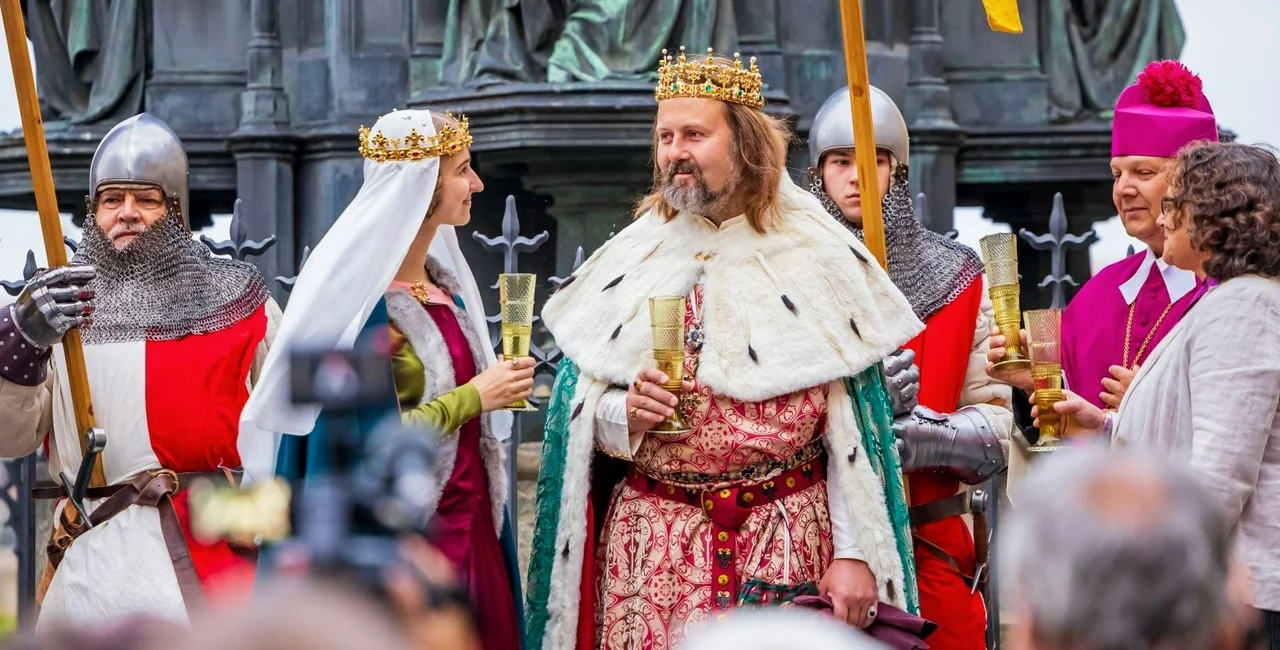
On Thursday morning, a costumed procession will recreate the laying of the bridge’s first stone, which tradition says took place on July 9, 1357, at 5:31 a.m.

The bridge anniversary spectacle is one of a handful of royal happenings this year that illuminate the revered medieval ruler Charles IV’s reign, and serve as a reminder of his lasting influence on Prague.

More than a bridge

Charles IV's legacy is largely associated with transforming Prague into a political and spiritual center of the Holy Roman Empire.

The new stone crossing was built after the earlier Judith Bridge, which had connected Prague’s banks since the 12th century, was badly damaged by a flood in 1342.

Completed in 1402, Charles Bridge became one piece of Charles IV’s vision, alongside the founding of Charles University, the development of Prague’s New Town, and the construction of major religious landmarks.

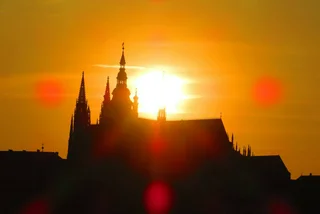
Charles IV also built Charles University, as well as St. Vitus the Gothic cathedral that dominates Prague Castle.

Fragments of Memory: The Treasury of St. Vitus Cathedral in the Mirror of Contemporary Art (ending July 26), displays a part of the emperor’s legacy that is often overlooked: his collection of sacred relics.

The exhibition places medieval reliquaries alongside works by nine contemporary artists, including Francis Bacon, Joseph Beuys, Magdalena Jetelová, Anselm Kiefer, Josef Koudelka, Gerhard Richter, Julian Rosefeldt, Edmund de Waal, and Mark Wallinger.

“We try to look at [the St. Vitus Treasury] with historical distance and present it from a contemporary perspective as the result of the deliberate and long-term collecting activity of our ancestors, as a sum of various stories, in other words, as a significant memory trace of Western civilization,” curator Jiří Fajt, told Novinky.cz.

Josef Koudelka’s large-format photographs document landscapes connected to the origins of many of the relics, including the Holy Land and its modern divisions.

Anselm Kiefer addresses the legacy of war and historical responsibility, while Francis Bacon’s Study of Pope Innocent X examines authority through a modern reinterpretation of one of Western art’s most recognizable religious figures.

From medieval treasures to crown jewels

Charles expanded the Treasury of St. Vitus Cathedral with relics gathered from across Europe, commissioning elaborate reliquaries made from gold, precious stones, crystal, and enamel.

One of the exhibition’s most significant objects is the Coronation Reliquary Cross, created in 1357, the same year traditionally associated with the founding of Charles Bridge.

The cross contains relics connected to the Passion of Christ, including fragments believed to come from the True Cross, a nail from the Crucifixion, and a piece of the sponge said to have been offered to Jesus.

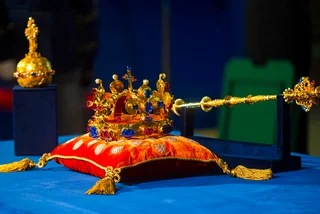
While Fragments of Memory explores sacred objects connected to the spiritual power of Charles IV’s reign, the Crown Jewels represent the political legacy of the Czech lands.

The centerpiece, the St. Wenceslas Crown, was created for Charles IV’s coronation as King of Bohemia and became a symbol of the kingdom itself rather than a personal possession of its rulers.

In September, Prague Castle will open the Bohemian Crown Jewels: Habsburgs 500 exhibition, marking the 500th anniversary of Ferdinand I of Habsburg’s accession to the Bohemian throne.

The exhibition will trace the journey of the jewels from their safekeeping at Karlštejn Castle through their transfer to Vienna during the Thirty Years’ War and their ceremonial return to Prague in 1791, when they became a modern symbol of Czech statehood, historical continuity, and national identity.

Charles Bridge: Both relic and reliquary

Like any landmark that has stood for nearly 700 years, Charles Bridge has become both a relic of Prague’s medieval past and a kind of reliquary of towers, statues, and stones that hold centuries of stories, from royal ceremonies to the myths and legends that have gathered around it.

The most famous claims that eggs were added to the mortar to strengthen the construction. While the story has never been confirmed, research has found evidence that medieval builders used unusual ingredients, including milk and wine, in construction materials.

Perhaps the bridge’s most enduring legend, however, is connected to the moment its foundation stone was laid.

According to tradition, Charles IV’s court astrologers selected the moment based on the position of the stars. The date and time also created a numerical curiosity: 1357, July 9, and 5:31 form a sequence of ascending odd numbers.

The symbolic ceremony will take place at 5:31 a.m., the traditional time of the original foundation ceremony, followed by Mass at the Church of St. Francis of Assisi at 7 a.m.

Over the centuries, Charles Bridge has carried merchants, pilgrims, horse-drawn trams, electric trams, and buses. It became fully pedestrianized in 1965 and today attracts millions of visitors who come for selfies and views of Prague Castle.

But for one early morning this week, the bridge will look like it did when Charles IV’s vision first began to take shape.

If you make the early start, expect medieval musicians, knights on horseback, and dancers accompanying figures representing Emperor Charles IV and his wife Anna of Svídnická.

July 9: Charles Bridge anniversary

5 a.m.: Charles IV procession from Lesser Town Bridge Towers across Charles Bridge to Křižovnické náměstí
5:31 a.m.: Symbolic tapping of the foundation stone at the traditional founding time
5:45 a.m.: Medieval music and court dances by ŘEMDIH and Regii Caroli regis
6:05 a.m.: Royal drummers, standard bearers, and fencing demonstrations'.
Early breakfast bonus: Charles Bridge Museum café opens early with egg dishes inspired by the bridge’s famous egg legend
7 a.m.: Anniversary Mass at the Church of St. Francis of Assisi

Did you like this article?

Want to see more from us? Select Expats.cz as a preferred source on Google.