
 Reading time: 2 minutes

 Summary for: Renovation in Czech town reveals what could be a centuries-old ossuary
Renovation work in the Central Bohemian town of Nymburk has uncovered human remains and historic masonry that may belong to a long-lost ossuary, a discovery that has also prompted concerns about how archaeological finds are being handled during construction.
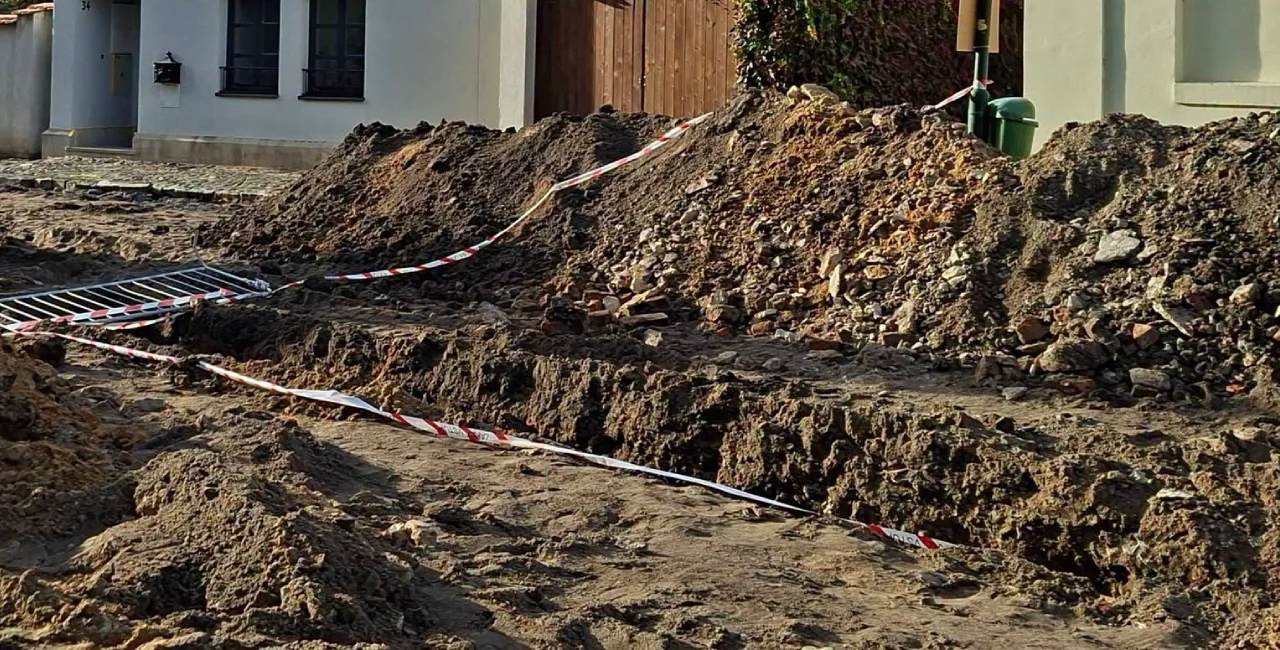
The remains were discovered beneath Kostelní Square in the town's historic center, where workers are carrying out a CZK 25 million reconstruction project. According to local historian and town councilor Pavel Fojtík, the uncovered walls may be part of a structure approximately 12 meters long that was previously known only through archival records.
Town officials have cautioned that the identification remains unconfirmed. They maintain that construction is proceeding under professional archaeological supervision and that all discoveries are being documented in accordance with regulations.
Ancient burial ground reveals human remains
Fojtík, a member of the local Starostové s Nymburskými demokraty political group, said the discoveries could help establish the precise location of an ossuary associated with the former cemetery surrounding the town's church.
"We knew from archival sources that an ossuary existed in the area of the former cemetery, but until now we didn't know exactly where it stood," Fojtík told the Czech News Agency. "We were surprised to find that it was a relatively large structure, approximately 12 meters long."
Excavations have also revealed sections of a former cemetery wall, scattered human bones and what Fojtík described as a roughly 10-centimeter layer of burned bones.
According to the historian, the human remains could date from the 13th to the 18th centuries, when the surrounding area served as a burial ground.

Fojtík shared photographs and concerns about the discoveries on Facebook, questioning whether the archaeological investigation is sufficiently thorough to preserve the site's historical information.
Town disputes criticism of archaeological work
Despite the potential significance of the discovery, Nymburk officials say further examination is necessary before the walls can be identified as belonging to the former ossuary.
"During excavation work, remains of walls were uncovered that are currently being surveyed and whose character and significance are being evaluated," town spokeswoman Marta Svobodová told the Czech News Agency.
She added that the location had previously undergone archaeological investigation and that the current discoveries were being properly documented.
Fojtík disagrees with the scope of the investigation, arguing that excavators are removing soil too quickly and potentially destroying evidence that should be carefully examined layer by layer.

He has also questioned the depth of excavation work associated with repairs to underground utility networks, claiming that some of the deeper digging was not originally planned.
The town disputes that assertion, maintaining that utility repairs were included in the project from the beginning and that archaeological supervision covers the entire construction site.

The renovation project, which began this fall, includes Kostelní Square and the neighboring Soudní and Na Fortně streets. It is scheduled for completion in 2027.
It remains unclear whether the archaeological discoveries will affect construction costs or the timetable. Further examination will be needed to determine whether the uncovered masonry is indeed part of Nymburk's historic ossuary.