Good afternoon, it's a hot one today, and the first of a couple of days when all-time temperature records could once again be broken in several parts of the country. Some more positive news on the economic front with strong growth numbers just out, and a Prague palace opens the doors to its air-conditioned spaces to the public as the heatwave hits. Here are today's top news.
This afternoon's top story
Abolition of ninth grade 'not on the table'
The possibility of abolishing ninth-grade classes in Czech elementary schools is not on the agenda of the day, Education Minister Robert Plaga said today after meeting with Prime Minister Andrej Babiš. According to Plaga, the alleged savings of CZK 50 billion that its suppression would mean - an argument put forward by House Speaker Tomio Okamura to promote the idea - are not a realistic estimate and "false information."
A "summer storm". The Education Minister described the current debate on the abolition of ninth grade as a "summer storm" with little basis in reality, and insisted it was precisely at that level of education that 15-year-olds were deciding on their future studies.
More top headlines
Czech economy grows by robust 2 percent
Czech GDP grew by 2 percent year-on-year in the second quarter of the year, according to a preliminary estimate released today by the Czech Statistical Office (CSZO). The positive economic numbers have taken some analysts by surprise, with Czech growth significantly stronger than most of the EU, which had.an average annual growth of just 1.2 percent in the second quarter.
The expert corner. "The Czech economy entered this year in relatively good shape and is so far resisting the oil shock," according to Deloitte's chief economist David Marek. "However, this has probably slowed down economic growth and the [Czech] economy is probably still slightly below its potential."
Czechia interested in hosting AI 'gigafactory'
The European Union just launched a tender to build up to seven huge data centers for AI across Europe, with the Czech Republic among the countries that have already expressed their interest and the project officially supported by the current government. Applicants have until November 12 to submit their bid, with the so-called 'gigafactories' set to be built from next year.
Footing the bill. According to early information, building such a facility in the Czech Republic could cost up about CZK 100 billion. Last year, Czechia already started construction on another, much smaller data center in Zbraslav, on the outskirts of Prague.
News you can use
Public transport used by over 1 billion passengers
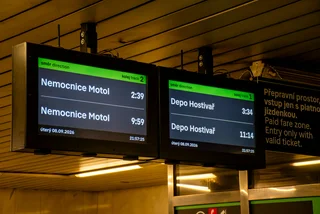
Prague's public transport system reported around 1.13 billion passengers in 2026, over 26 million more than the year before, according to the Technical Administration of Communications (TSK). Of that total, metro users (370 million) just barely outnumbered tram commuters (368 million), but both are well ahead of bus users (283 million).
PID in numbers. Excluding the suburbs, the Prague Integrated Transport (PID) system last year operated three metro lines, 36 tram routes, 183 bus or trolleybus lines, on top of 40 trains, five ferries and the Petřín funicular - due to reopen this year. Including both Prague (229 lines) and the suburbs (175), PID in total operates more than 400 public transport lines.
Škoda Palace opens to public to escape heatwave
The air-conditioned spaces on the ground floor of the Škoda Palace, in Prague's city center, are being open to the public for the duration of the ongoing heatwave, municipal spokesman Vít Hofman announced today, adding that all visitors can use the premises to cool off, rest, use the bathroom or drink water.
Opening hours. The Škoda Palace is located on Jungmannova street and will be open to the public on Thursday and Friday between 8 a.m. and 6 p.m.
POLL RESULTS: After Prague Pride organizers announced increased security measures for this year's festival, we asked Expats.cz readers if they feel sale attending large public events in Czechia. Two-third of you said they do, and another 23 percent said they feel "mostly safe" but remain aware of the security risks. Just 4 percent said they do not feel safe in light of recent events.