



 Reading time: 3 minutes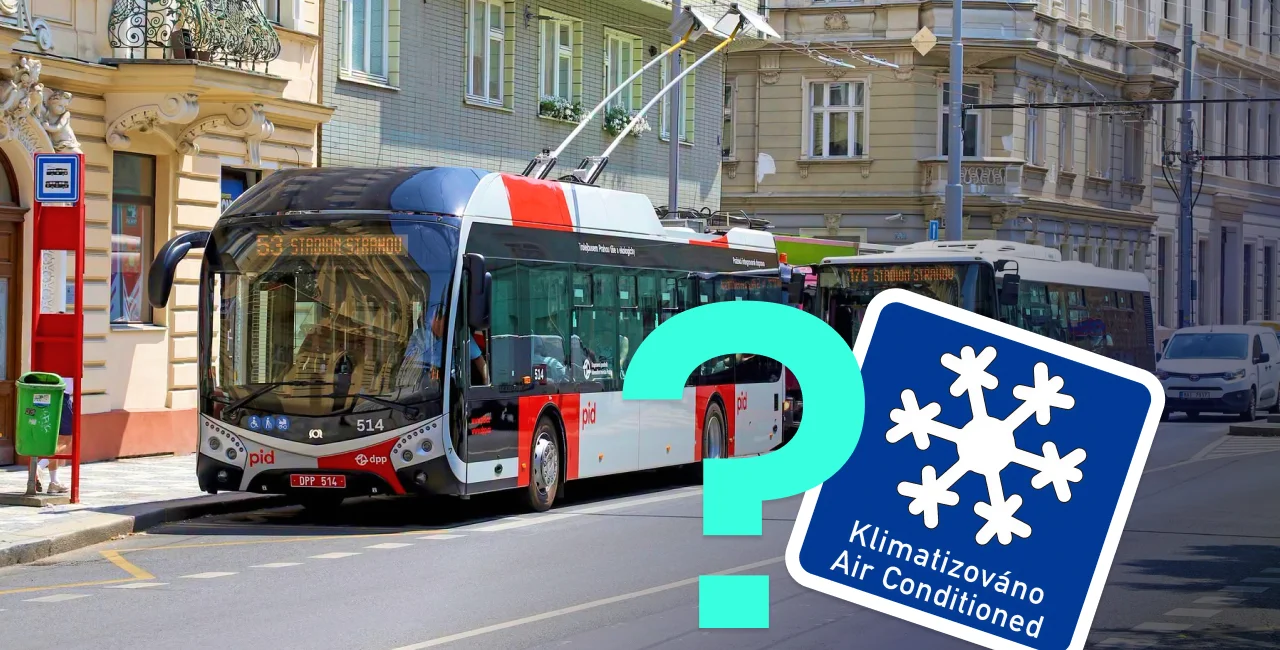

 Summary for: Why 'air-conditioned' doesn't always mean ice-cold on Czech public transport
As Czechia battles record-breaking heat, with a new wave of stifling temps possibly ahead this month, commuters continue to face grueling journeys on inner-city trams and buses and long-distance trains.
New findings from Seznam Zprávy, have found that within the capital, the sauna-like conditions of trams and buses are making commutes increasingly uncomfortable, even when a tram or bus is indicated to have A/C.
The publication reports that Prague Integrated Transport (ROPID) has stepped up random inspections and is currently fining transport operators whose cooling systems are completely non-functional.
However, transit officials are also reminding passengers that public transit will never feel ice-cold especially during extreme heatwaves due to health regulations and older vehicle fleets.
Who controls the air conditioning?
Only about 19 percent of Prague's tram fleet (147 out of 772 vehicles) is equipped with air conditioning. In contrast, roughly 73 percent of city buses and 100 percent of the new trolleybuses are fully air-conditioned, according to the Prague Public Transport Company.
According to Filip Drápal, spokesman for ROPID (Regional Organizer of Prague Integrated Transport), the obligation to turn on the air conditioning occurs if the outside temperature exceeds 22 degrees Celsius.
Drápal tells the publication that each type of vehicle has its air conditioning system set differently.
For example, trams and some of the latest types of buses have an automatic mode that is not controlled by the driver. However, most types of buses have manually adjustable air conditioning, and the driver can also set a specific temperature.

Why aren't air-conditioned vehicles cooler?
According to ROPID, AC units are legally regulated to keep the interior only 1 to 6 degrees Celsius cooler than the outside temperature.
That means on days when outside temperatures approach a blistering 39°C, the interior of a fully functioning Prague bus or tram will legally and intentionally hover around 33°C, recommendations given by hygienists and health professionals, says Drápal.
Of course, opening windows on an air-conditioned vehicle actively derails the automated climate systems and makes the vehicle hotter. The effectiveness of the air conditioning is also reduced when the vehicle doors are regularly opened at stops.
On buses, city regulations prevent drivers from idling their engines at final stops. Consequently, buses cannot pre-cool, leaving the vehicle intensely hot during the first few stops of a route.


Can you complain?
If you encounter a vehicle where the cooling is entirely broken, you can alert the driver, or log a complaint with ROPID, though transit authorities note that technical faults are incredibly difficult to prove retroactively.
It's not just city transport facing steamy rides. Over the weekend, Czech Railways passengers on the Hamburg-Prague route were left without air conditioning, with some reports saying that passengers suffered 50°C heat.
Meanwhile, hundreds of other passengers were stranded on Sunday on a RegioJet train from Budapest to Prague without air conditioning.
A RegioJet spokesman told Seznam Zprávy that neither the driver nor the staff have any influence on the functionality of the air conditioning, because it is controlled automatically in buses and trains. Passengers are entitled to 100 percent ticket compesnation if they cannot be moved to another carriage.
On České dráhy, broken AC on domestic routes gets you a rather modest CZK 30 voucher if requested from the conductor during the trip, while international routes qualify for 25 percent of the ticket price.


Is there any relief?
Older trams and buses without air conditioning typically still have opening windows, a feature newer air-conditioned vehicles are increasingly built without, since open windows undercut a working AC system.
FlixBus, for instance, has removed opening windows from its buses for exactly this reason. Some long-distance operators equip vehicles with backup roof fans as a fallback if the main air conditioning fails.
Our own take: on an extremely hot day, an older, emptier tram with the windows open may beat a crowded "air-conditioned" one running below capacity.