
 Reading time: 5 minutes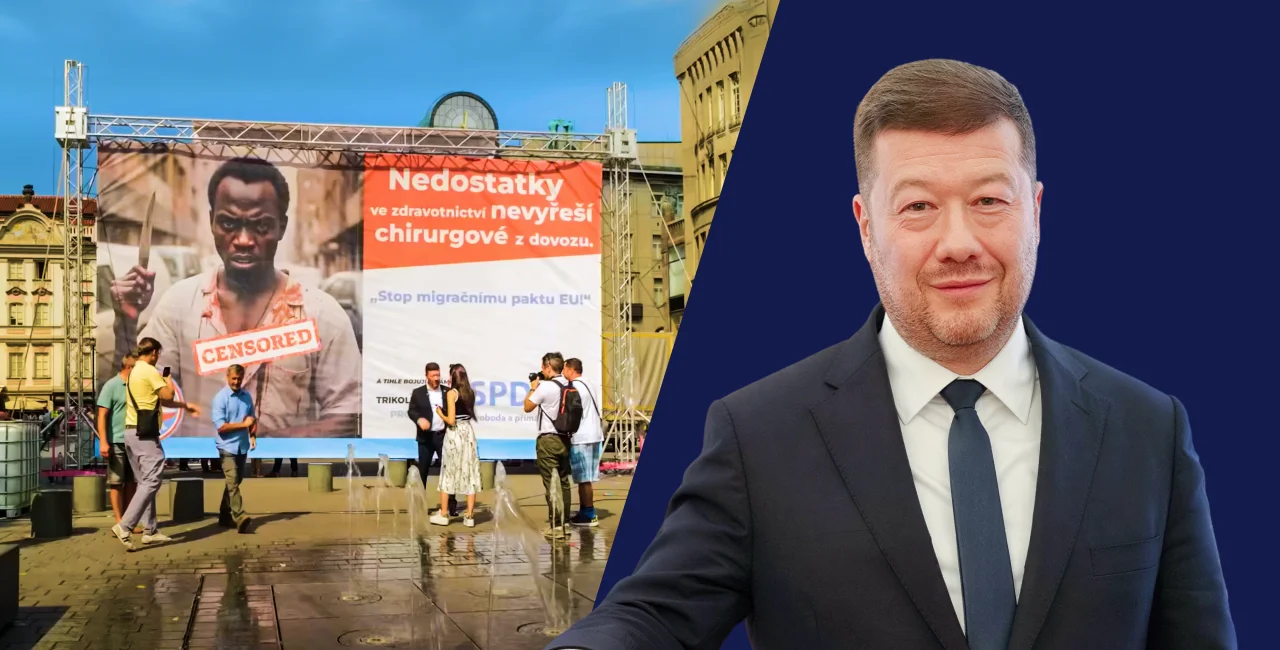

 Summary for: EXPLAINED: Where does free speech end and hate speech begin in Czechia?
In September 2024, massive campaign posters showing a dark-skinned man wielding a bloodied knife appeared across Prague, accompanied by a warning about “surgeons” coming from abroad. Another showed two Roma boys smoking, alongside a message criticizing parents who do not ensure their children attend school.
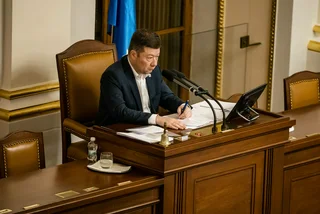
The images were produced not by an extremist fringe group, but by the Freedom and Direct Democracy (SPD) movement led by Tomio Okamura, now speaker of the Chamber of Deputies.

On Tuesday, a Prague appeals court ruled that the controversial campaign did not constitute incitement to hatred or another criminal offense, overturning a previous ruling that had fined SPD CZK 3 million.
The decision raises a broader question of where Czech law draws the line between political speech that is provocative or offensive and speech that becomes criminal hate speech. The case shows how difficult that line can be to draw.
A campaign designed to provoke
The case concerns two posters used by the SPD-led coalition during the 2024 regional and Senate elections.
One depicted a dark-skinned man in a bloodstained shirt holding a bloodied knife. The accompanying text said: “Shortcomings in healthcare will not be solved by imported ‘surgeons’” and called for a halt to the EU Migration Pact.

The second showed two Roma boys smoking a cigarette. Its text read: “They tell us to go to school, but our parents don't care…” followed by a call for social support only for families whose children attend school.
The campaign drew complaints and eventually led to criminal proceedings against SPD and Okamura.
SPD has consistently denied wrongdoing, arguing that the posters expressed its political positions on migration, healthcare and alleged abuse of the welfare system.
The original court's reasoning took a different view of the SPD campaign. Prosecutors argued that the knife poster could generate fear, disgust, and a sense of threat toward migrants, while the Roma poster reinforced stereotypes portraying Roma people as irresponsible and as abusing the social system.
In June, it found SPD guilty of incitement to hatred and imposed the CZK 3 million fine. That decision was not final and was appealed. On Tuesday, the appeals court overturned it.
‘On the verge of good taste’
Judge Monika Kříkavová, who chaired the appeals panel, did not dispute that the campaign was deliberately provocative.




“The language used was forceful, oversimplified, at times provocative, and on the verge of good taste,” she said.
But that did not make it criminal, she said. Political campaigns and debates are inherently confrontational, and a democratic legal system must be capable of tolerating even highly provocative political expression.
A Prague appeals court cleared SPD over campaign posters showing a bloodied, knife-wielding man and two Roma boys smoking, ruling that the provocative images did not amount to hate speech. Where should Czechia draw the line on political speech?
The court also distinguished between the two posters.
The image of the dark-skinned man was interpreted as a symbolic statement and value judgment concerning EU migration policy and security risks associated by some members of the public with migration.
The Roma poster was considered an expression of a political opinion about how to address social problems, the judge said.
“The subject of these proceedings was not to evaluate the correctness of the defendant's political views,” Kříkavová said. A criminal court's task was instead to determine whether the boundaries set by criminal law had been crossed.

Simply raising an issue or criticizing an existing policy, she added, cannot automatically be considered hate speech.
So where is the legal line?
Czech law does not make “offensive speech” a criminal category in itself. The Criminal Code specifically prohibits publicly inciting hatred against a nation, race, ethnic group, religion, class or other group, as well as inciting restrictions on the rights and freedoms of its members.
When the offense is committed through media, television, radio, film, or a publicly accessible computer network, the potential penalty is higher.

Separate provisions also criminalize publicly defaming a nation, race, ethnic group or other protected group.
Two Czech courts have now reached opposite conclusions: the first found that SPD crossed the criminal-law boundary, while the appeals court ruled that the posters, though provocative and “on the verge of good taste,” remained protected political speech.

The legal question is not simply whether speech is offensive, but whether it crosses from political expression into inciting hatred, violence or the suppression of a protected group’s rights.
The debate over hate speech
The Institute for Danube Region and Central Europe, which examined the campaign when the posters appeared in 2024, described them as “overtly racist and biased” and questioned whether their use in an election campaign could amount to a crime.
Political philosopher Roman Joch, speaking to Czech Radio earlier this year, argued that political speech deserves especially strong protection because voters must be free to criticize government policy and demand political change.
Joch said he personally considered the SPD posters vulgar and offensive, and said he found the knife poster particularly objectionable, but argued that this did not necessarily make the campaign criminal.
The public prosecutor said he would consider filing a petition for appellate review.
Okamura says the ruling vindicates him
Okamura welcomed Tuesday's decision, saying it confirmed the movement's right to freedom of expression.

He also argued that the ruling should lead to the end of his own criminal prosecution in the case.
His situation is separate from that of SPD. Okamura was also charged, but his prosecution is currently suspended because the Chamber of Deputies did not lift his parliamentary immunity to allow the criminal proceedings to continue. His case will therefore be dealt with separately.
Okamura has consistently characterized the prosecution as politically motivated and denied wrongdoing.
The bigger question for Czechia
A June 2026 survey by Czech Radio and the CVVM polling institute found that a majority of Czechs believe freedom of expression should have limits, including when speech threatens security, democracy, or encourages hatred. At the same time, attitudes vary significantly by political affiliation, with SPD supporters among the most resistant to restrictions.
Czech law protects political speech even when it is inflammatory, offensive or unpopular. But it also sets criminal limits when speech becomes an incitement to hatred or an attack on the rights of protected groups.

In this case, the appeals court has drawn that line on the side of free expression with its message that being provocative, offensive or “on the verge of good taste” is not, by itself, enough to make political speech a crime.