


 Reading time: 4 minutes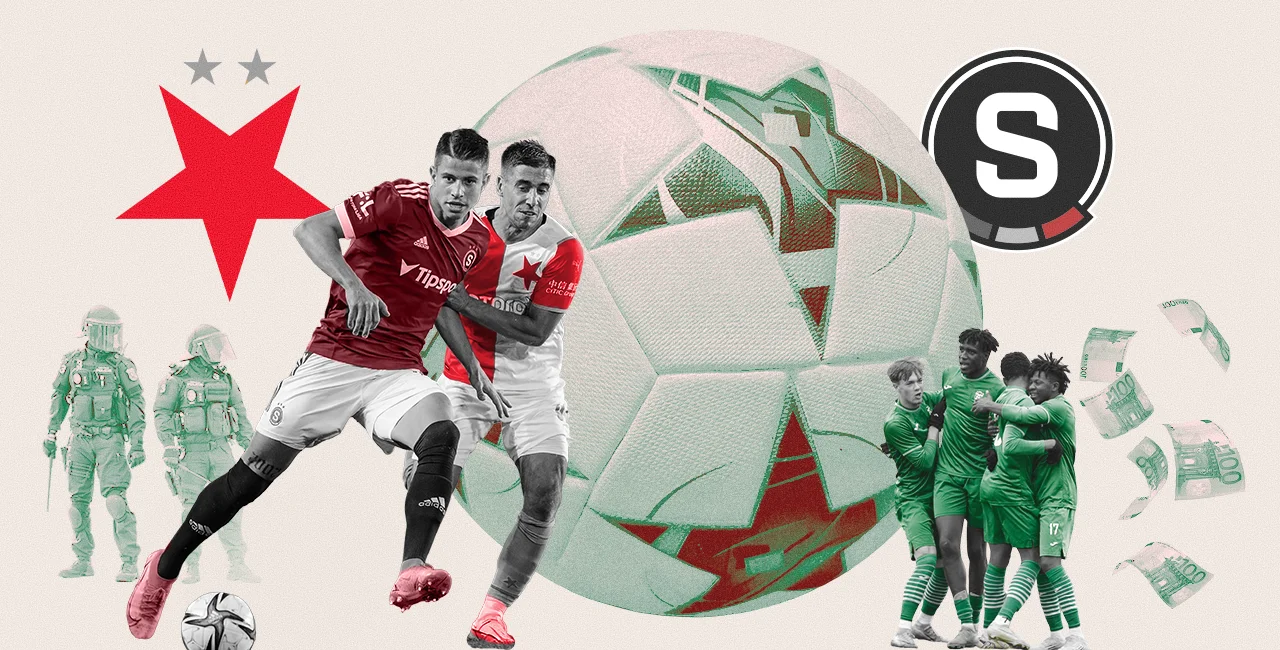

 Summary for: EXPLAINED: Why Czechia’s World Cup return kicks off amid historic scandal at home
For the first time in two decades, Czechs are heading to the FIFA World Cup hosted this year by Canada, the United States and Mexico.
The Czech Football Association recently unveiled the preliminary World Cup squad with 54 players.
Although the final 26-man team for the tournament will be announced later, the shortlist includes two Slavia Prague players – defender David Douděra and striker Tomáš Chorý – who have already been forbidden from representing their league team ever again since the dramatic derby against arch-rivals Sparta.
With football fans and officials now debating whether the pair should be allowed to go to the World Cup, what should have been a year of celebration and rejoicing for Czech football – regardless of their final performance across the Atlantic – is being spoiled by two recent scandals that rocked the domestic football scene.
When to watch Czechia’s World Cup fixtures? The Czech national squad will have their opening match against South Korea in Guadalajara on June 12 (4 am Prague time), followed by their second group-stage game against South Africa in Atlanta on June 18 (6 pm) and a face-off against hosts Mexico in Mexico City on June 25 (3 am).
Within the space of two months, Czech football has been upended by the largest corruption scandal in its history and one of the most violent fans incidents in living memory.
For a country that strives to be taken seriously on the European and international stage, this might be a make-or-break moment to fix its issues, reboot, or fall back into its old ways.
Corruption, easy-money, and match-fixing
Throwback to March. Just two days before the Czech team’s World Cup semi-final playoff against Ireland, the entire sport faced what Czech Football Association president David Trunda described as “probably the largest operation in the history of Czech football.”

In a sweeping anti-corruption operation, dozens of people were detained and nearly 50 disciplinary proceedings were immediately opened against players, referees, officials and football clubs, with more following in May.
By the end of March, over 30 people were already charged by Czech authorities, and a dozen defendants confessed earlier this month to taking part in match-fixing. Others have continued to deny involvement in any illegal activity.
Unprecedented in recent history, the scale of the bribery, illegal betting and game-rigging scandal extends from youth competitions to Czechia’s topflight, concerns key defendants like Karviná mayor and former club head Jan Wolf, involved Europol and Interpol in a years-long investigation, and included elaborate schemes to travel to Vienna to get earnings received via higher-odds Asian betting websites.
“We will do everything to ensure that the betting mafia disappears from Czech sports,” Football Association chairman David Trunda promised.
But every week, new details are emerging from the criminal activities of what investigators suspect could be an organized, structured and hierarchical group with deep roots and vast resources. One fell swoop might not be enough to unroot that scourge.
Football hooliganism in the Czech Republic. Originating from a set of subcultures in 1950s and 1960s England, football hooliganism also developed into an organized subculture in the Czech Republic in the 1990s and early 2000s. Structured and “professionalized” hooligan groups replaced informal networks, adopting their own set of customs, practices and internal rules.

Too early to the party
Then came the rioting, when hundreds of Slavia Prague supporters stormed the pitch of the Fortuna Arena at the 97th minute of the derby against rivals Sparta earlier this month, robbing their own team of the league title just minutes before the end.
Flares and pyrotechnics were thrown towards opposing fans, Sparta players were assaulted, riot police were called in, and the game was eventually abandoned – only the third time in modern Czech history that fan violence forced an abandonment.
Days later, the Czech Football League Association handed Slavia a 0:3 loss by default, imposed the maximum fine of CZK 10 million on the Vršovice club and forced the team to play its remaining four league games behind closed doors without spectators – which also means a loss in revenues of millions of crowns.
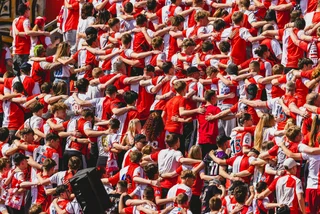
The chairman of the Czech Football Associations’ ethics committee Jiří Matzner didn’t mince his word: “This is one of the most serious and reprehensible moments in the history of Czech league football,” also warning that such incidents have far-reaching consequences and undermine the public’s trust in professional football as a whole.
Slavia’s later victory against FK Jablonec eventually gave them an unassailable lead over Sparta, allowing them to secure their 23rd top-league title. But the celebrations, here again, turned into a bitter-sweet episode as excluded fans were forced to cheer from outside their team’s stadium.

Pledges to reform and atone for what happened were swiftly expressed, with Slavia club chairman Jaroslav Tvrdik promising to make Eden “the safest stadium in the country.”
Doživotnà zákaz vstupu
— SK Slavia Praha (@slaviaofficial) May 10, 2026
PÅ™edstavenstvo SK Slavia Praha udÄ›lilo doživotnà zákaz vstupu do Fortuna Areny návÅ¡tÄ›vnÃkovi, který bÄ›hem derby neoprávnÄ›nÄ› vstoupil na hracà plochu a napadl Jakuba SurovÄÃka.
DotyÄný byl identifikován na základÄ› kamerových záznamů a spolupráce… pic.twitter.com/gaqWyVkHed
Ultras and hooligans. Separate from but sometimes overlapping with the more numerous hordes of “ultras”, about 30 hooligan gangs are active in the Czech Republic today, each with dozens of members. Relations between some of them – including AC Sparta and SK Slavia – are notoriously confrontational, but some groups have historically stroke mutual partnerships across borders, including FC Brno and ŠK Slovan Bratislava or FC Baník Ostrava and GKS Katowice.
The 2026 World Cup would be an opportune moment for Czech football to strengthen its international reputation.
The talent is real and recognized, with some players for the World Cup squad playing in some of Europe’s top clubs like Lyon or Leverkusen. It might also, some hope, be a golden opportunity to address structural problems and finally put its house in order.