Reading time: 2 minutes

 Summary for: Thousands rally in central Prague as Czech TV and radio employees strike
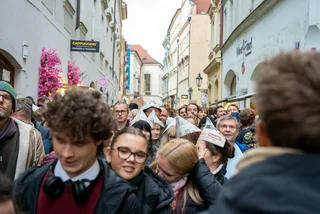
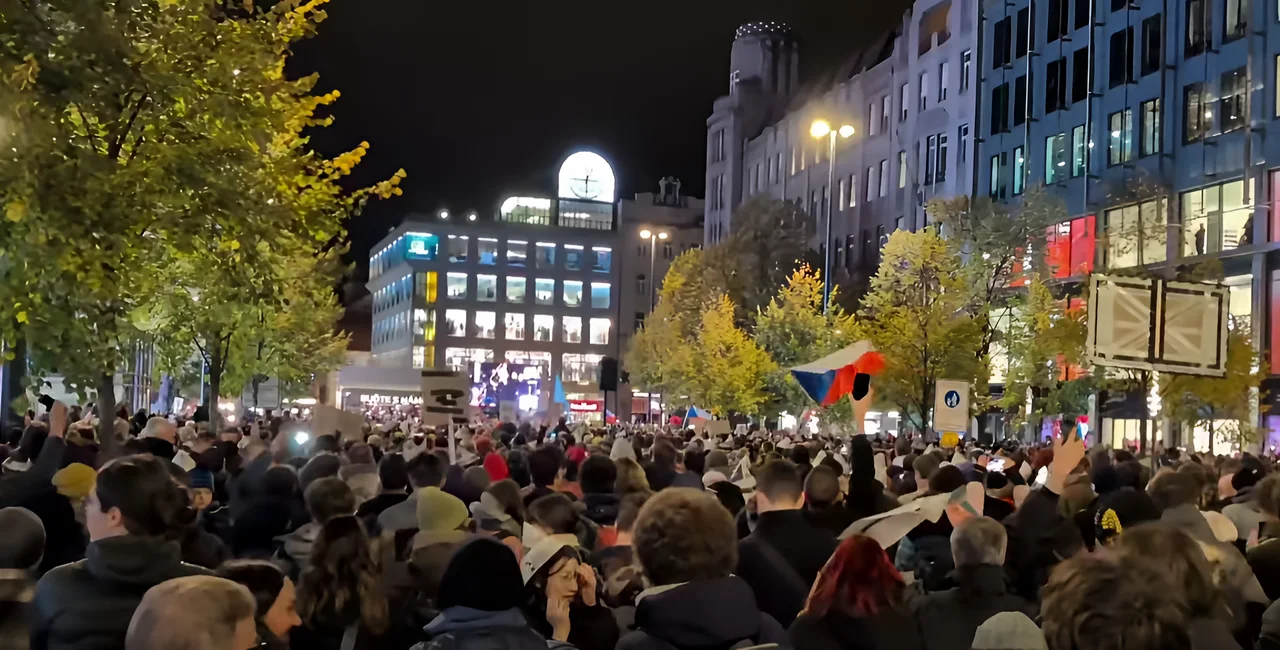
Thousands of people gathered in Prague’s Wenceslas Square on Tuesday to support the independence of Czech Television and Czech Radio as employees of both broadcasters staged a daylong strike.
University students joined broadcasting staff and other supporters protesting the government’s proposal to abolish television and radio license fees and replace them with state-budget funding.

The main program began symbolically at 4:36 p.m., echoing the early-morning parliamentary vote that advanced the legislation through its first reading Oct. 24.
Marches converge on Wenceslas Square
Striking employees arrived in processions from the broadcasters’ headquarters. Czech Radio staff walked from nearby Vinohradská street, while Czech Television employees traveled several kilometers from the Kavčí hory complex.
Students also approached the square from several locations across Prague.
Charles University students gathered at Albertov before marching with chants of “We’re with you.” Participants from the university’s Faculty of Social Sciences, which teaches journalism, arrived chanting “We won’t give up the media.”
Students from other faculties carried banners and joined the demonstration, alongside participants marching from the Prague University of Economics and Business.


Actor and director Jiří Mádl addressed the crowd before the main program. He argued that abolishing fees would leave people paying through taxes while giving the government greater influence over broadcast content.
Mádl also appealed to supporters of the current coalition, warning that any future government could inherit that influence—including one whose politics they oppose.
Funding dispute brings broadcasting changes
The demonstration accompanied a strike that began after midnight Tuesday, reducing live programming and news coverage across Czech Television and Czech Radio.
ČT24 switched to short hourly news bulletins interspersed with archive programs. Radiožurnál retained basic news and traffic updates while replacing much of its regular schedule with music and repeats. Both broadcasters maintained their children’s programming.
Employees argue that the proposed funding system, which would also provide substantially less money, threatens editorial and financial independence, long-term stability and their ability to deliver public services.

The bill remains under parliamentary consideration. It has not abolished the existing fees.
Government representatives reject the claim that changing the funding model would undermine independence. They argue that license fees are only one of several approaches used across Europe.
Prime Minister Andrej Babiš says abolishing the fees fulfills an election promise and denies seeking control over editorial decisions.
On Saturday, he also outlined a possible alternative involving voluntary fees and guaranteed funding outside the state budget, although the mechanism remains unspecified. He said the legislation would not take effect in January 2027 and promised further parliamentary discussion.
Tuesday’s gathering adds to demonstrations held since the bill’s first reading. Students are preparing another protest Nov. 10, while Milion chvilek pro demokracii has announced a Nov. 15 rally at Letná.