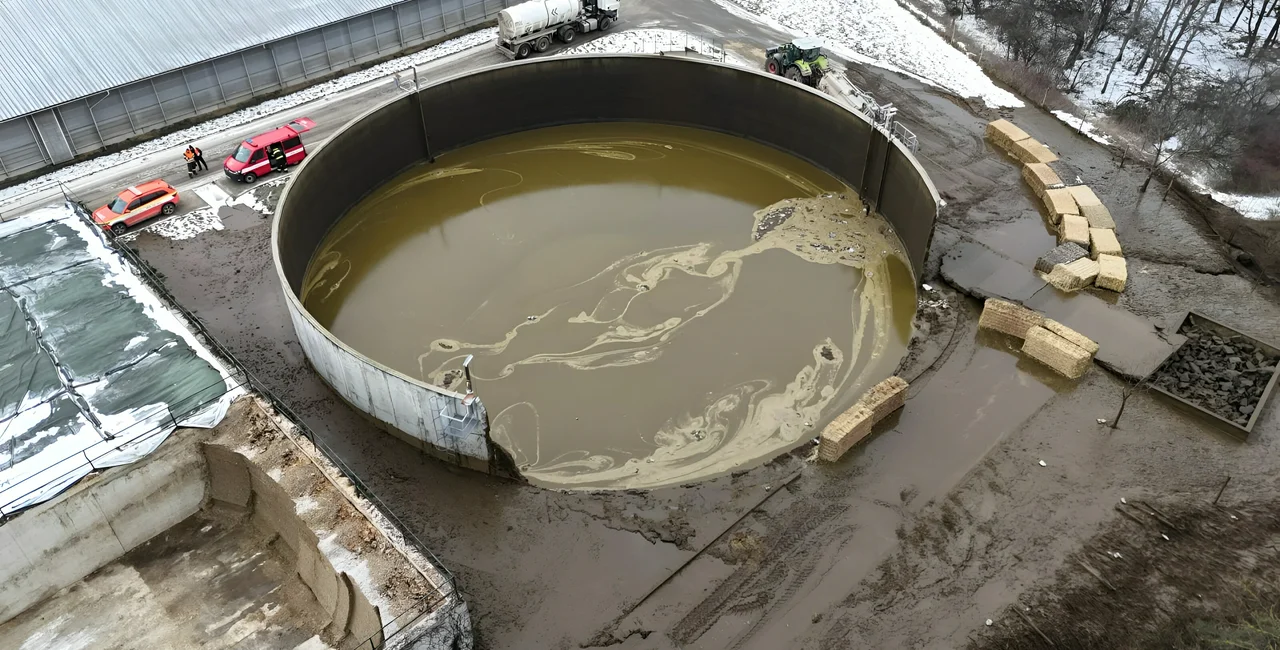
A ruptured farm tank near Podmyce in South Moravia sent thousands of cubic metres of liquid manure into the River Dyje, reaching the Podyjí National Park and crossing into Austria, officials said.
Water-diluted manure flowed slowly downstream, diluting as it went. On Monday, water managers measured ammonia levels up to four times the legal limit in Vranov nad Dyjí, but no fish deaths were reported.
Authorities estimate that as much as 3,000 cubic metres of manure leaked from the 6,000-cubic-metre tank at the Petřín Agricultural Cooperative, part of Rhea Holding.
Police have opened criminal proceedings for environmental damage and negligence.
“We are evaluating the circumstances,” said Bohumil Malásek, a police spokesman. So far, no charges have been filed.
The spill also affected parked cars and one building in Vranov nad Dyjí, where the liquid manure flooded Junácká louka Street.
Mobile chemical lab, drones monitoring
Firefighters responded early Monday, sending a mobile chemical laboratory and drones to monitor and contain the contamination.
“After the sudden destruction of the wall of the tank, a massive wave of liquid manure was released, which spread through the valley towards Vranov nad Dyjí,” the local fire department reported.
Josef Kolář, director of the agricultural company, said the tank was roughly nine years old and regularly inspected. “It was not completely full; whether frost caused the damage, I don’t know,” he said. Remediation and pumping efforts continue in cooperation with local authorities.
The Morava River Basin Authority is tracking the manure’s progress and testing water quality along the Dyje towards the Znojmo reservoir, which supplies drinking water to the town and surrounding communities.
“We are monitoring ammonia concentrations to ensure water safety,” spokeswoman Jana Kučerová said.
Authorities said the spill reached the Austrian town of Hardegg by noon on Monday. While the contamination is gradually weakening, officials remain vigilant because the Znojmo reservoir is still miles downstream.
Ammonia naturally oxidizes and evaporates over time, helping reduce the environmental impact.
Residents are advised to avoid direct contact with river water until authorities confirm that concentrations have returned to safe levels