What happened in Munich? Macinka's viral Clinton clash exposes a divided Czechia

The Czech foreign minister; culture-war pivot from Ukraine was the defining symbol of Munich's deepest tension: populist vs. progressive visions of the Wes

ČTK Elizabeth Zahradnicek-Haas

Written by ČTKElizabeth Zahradnicek-Haas Published on 16.02.2026 09:18:00 (updated on 16.02.2026) Reading time: 3 minutes
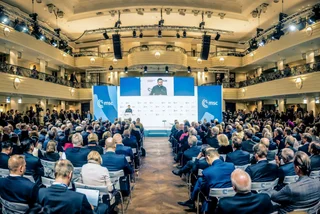
Czechia's deepening political divide played out on the world stage at the Munich Security Conference (Feb. 13-15, 2026), where Foreign Minister Petr Macinka's viral clash with former U.S. Secretary of State Hillary Clinton exposed competing visions for the nation's foreign policy.

The heated exchange, which quickly pivoted from the war in Ukraine to culture wars, was praised by Barron Trump and conservative media. Czech opposition leaders, however, issued sharp rebukes of Macinka's behavior in Munich.

The viral moment captured Munich's central tension: a widening gap between populist and progressive views of Western values.

Clinton-Sikorski vs. Macinka

The clash saw Czechia's foreign minister align with cultural positions that EU leaders had explicitly rejected throughout the conference.

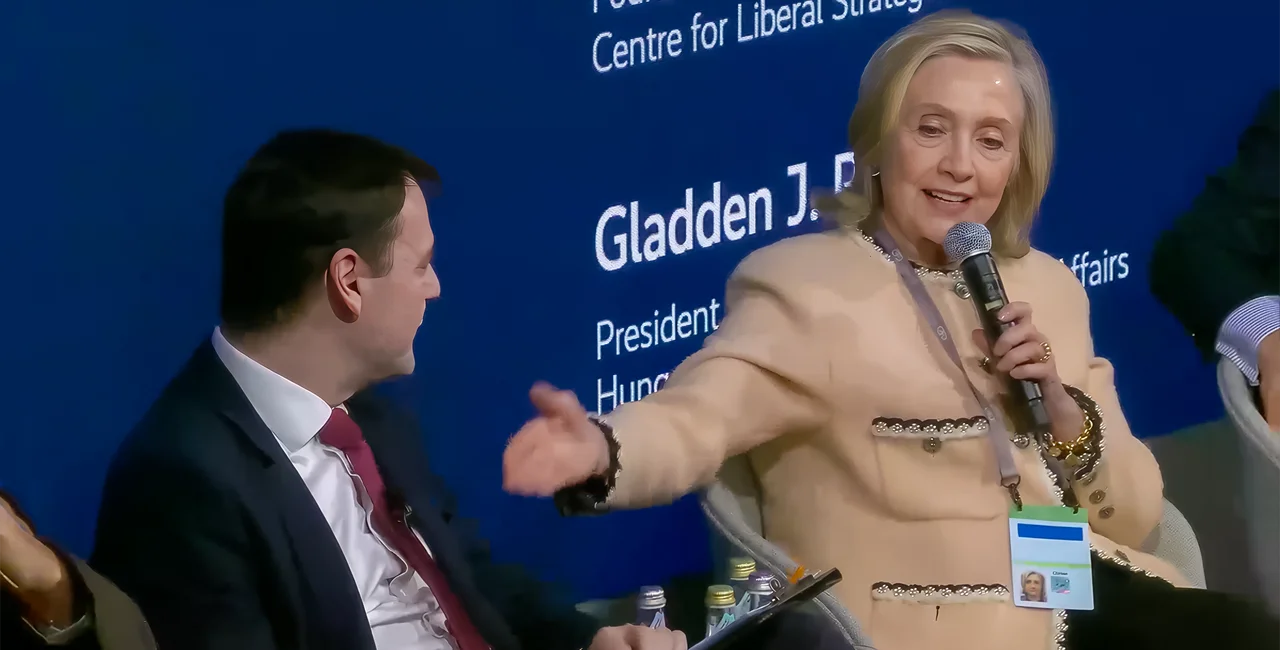
During Saturday's panel titled "The West–West Divide," which Macinka co-led with Polish Foreign Minister Radosław Sikorski, the Czech minister challenged Clinton's assertions regarding Western values and support for Kyiv.

While Clinton argued that abandoning Ukraine would be "traitorous," Macinka shifted focus to internal Western policy, attacking "climate alarmism" and the "woke movement."

"Does that justify leaving people in Ukraine on their backs dying on the front lines to save their freedom and their two genders, if that's what's bothering you?" Clinton asked in a sharp rebuttal that quickly circulated on social media.

Sikorski challenged Macinka's arguments throughout the panel. When Macinka questioned the democratic link between voters and the European Commission, Sikorski delivered a pointed civics lesson: Czech ministers are not directly elected either—parliament decides the government's composition, just as the European Parliament approves the Commission.

Prague's response

The performance drew immediate condemnation from opposition figures in Prague.

STAN Chairman Vít Rakušan labeled the incident a "Munich embarrassment," stating that Macinka's arguments served as a "lousy calling card" for the Czech Republic.

ODS Chairman Martin Kupka compared the foreign minister to a "boxer from the district championship" who did not belong on the stage of international politics.

Czech European Commissioner Jozef Síkela thanked Sikorski "for his patience in refuting anti-EU disinformation nonsense."

The broader debate

Macinka's clash was one of several playing out across the three-day conference. German Chancellor Friedrich Merz opened the conference Feb. 13, declaring "the culture war of the MAGA movement is not ours."

The next day, U.S. Secretary of State Marco Rubio called for a return to shared values, including "Christian faith, culture, heritage, language, ancestry, and the sacrifices our forefathers made together."

Czech President Pavel said Rubio's speech "dispelled fears" by emphasizing shared strategic goals. Pavel noted that on Friday, "there was still an atmosphere of concern in transatlantic relations," but found Rubio's criticism of Europe "much more constructive" than anticipated.

On the conference's final day, EU High Representative Kaja Kallas pushed back: "Contrary to what some may say, 'woke decadent' Europe is not facing civilizational erasure." The former Estonian prime minister noted the irony of U.S. press freedom criticism from a country ranked 58th while Estonia ranks second.

The U.S. National Security Strategy has labeled Europe a "civilization in decline."

Two Czech visions

While President Pavel warned against "Munich spirit" peace deals made without Ukraine and emphasized Czechia's ammunition initiative—which has delivered over 4 million shells—Macinka took a different stance.

Speaking to iROZHLAS.cz Macinka expressed doubt Ukraine could defeat Russia militarily, calling for a ceasefire as "the first step." He said of the panel debate, "I expressed some opinions there, and I think it was one of the most lively panel discussions of the conference." Macinka meets Sikorski in Warsaw on Monday.

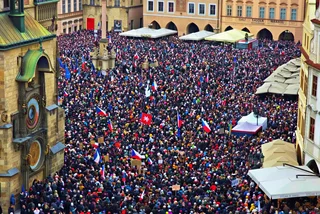
Meanwhile, the Million Moments association has announced plans for a March 21 rally at Prague's Letná to support President Pavel in his ongoing clash with Macinka over alleged blackmail. The opposition's first no-confidence vote has already failed, but nearly 770,000 people have signed an appeal backing the president.

Did you like this article?

Every business has a story. Let's make yours heard. Click here