



 Reading time: 3 minutes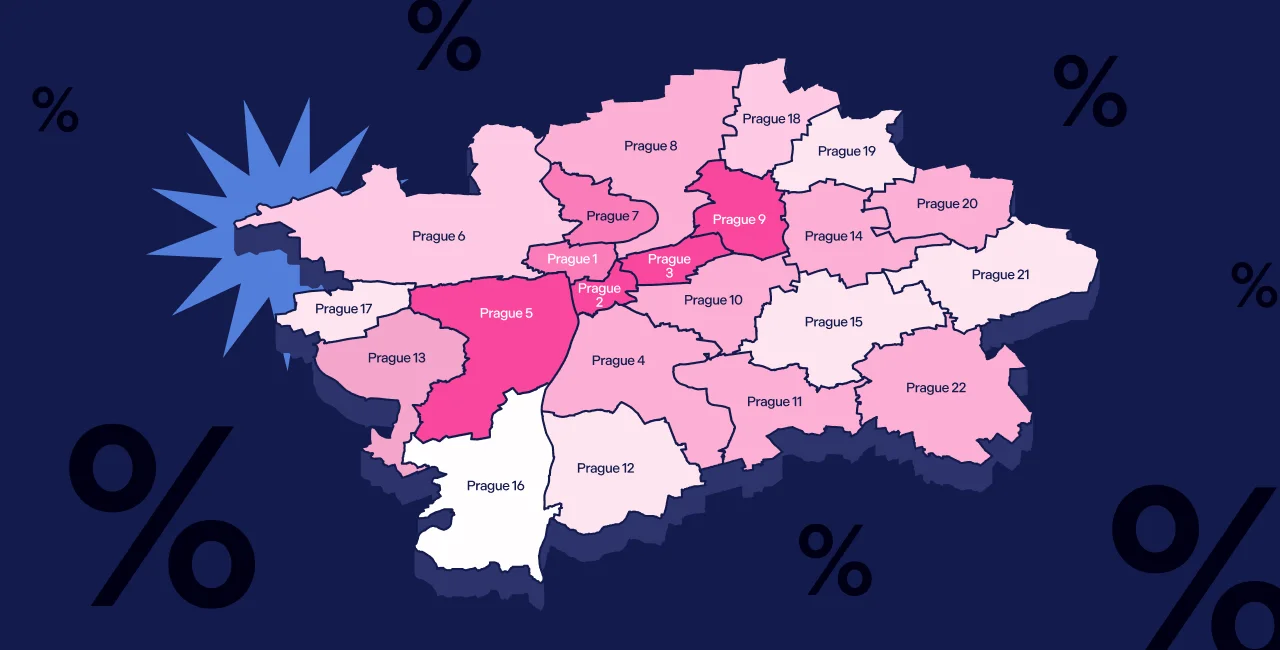

 Summary for: VISUALIZED: Prague's most diverse neighborhoods mapped
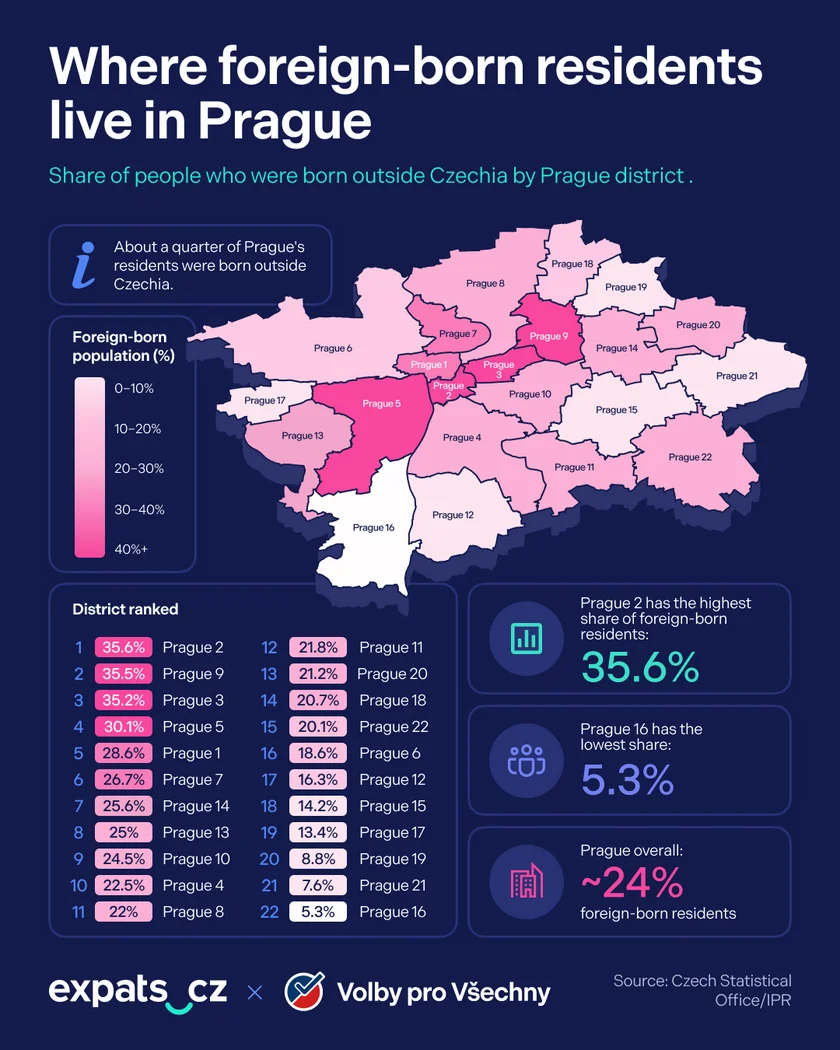
About a quarter of Prague’s residents were born outside Czechia; but they are not evenly distributed across the city. Some districts are highly international, while others remain predominantly Czech. The difference between them is not just statistical: it shapes daily life, local services, and even who participates in local decision-making.
Before looking at the maps, it’s worth clarifying terms.

Who are we talking about?
There is no perfect word. “Foreigner,” “expat,” and “migrant” are often used, but each carries assumptions. In this article, we use the most neutral (if slightly awkward) term: people with a migration experience. This includes anyone living in Prague who was born outside Czechia, regardless of citizenship, reason for moving, or how long they’ve stayed.
Why does this matter at the neighborhood level?
Because where people with a migration experience live is not random.
In Prague, international residents often cluster in specific districts, sometimes around schools, workplaces, language networks, or established communities. Over time, this creates visible neighborhood patterns.
Prague 5 has a noticeable French-speaking community, partly linked to the Lycée Français. Prague 2 has a long-standing Italian presence, especially around Vinohrady, where “Little Italy” has gradually taken shape.

Other districts show different but equally distinct international profiles.
These clusters matter for practical reasons: they shape where people find services, schools, food, and community networks that make daily life easier in a new country.
But they also matter beyond where to get great pizza.
In areas with higher concentrations of foreign-born residents, communities can reach a scale where they are not just present, but potentially influential whether as voters or voices at the City Hall level or in a local district.
EU citizens: a more direct form of influence
This is particularly true for EU nationals living in Czechia. Unlike most non-EU residents, they can vote in municipal elections.
That means they already have a formal role in shaping local government, from neighborhood priorities to city services. In some Prague districts, the number of EU citizens is large enough that, if turnout is high, they could meaningfully influence outcomes.
What the data shows
The differences between districts are striking.
Prague 2 stands out, with around 35.6 percent of residents born outside Czechia, more than one in three people. In practical terms, this makes international life the norm rather than the exception.
At the other end, Prague 16 has just 5.3 percent foreign-born residents, showing how sharply the city changes from one district to another.

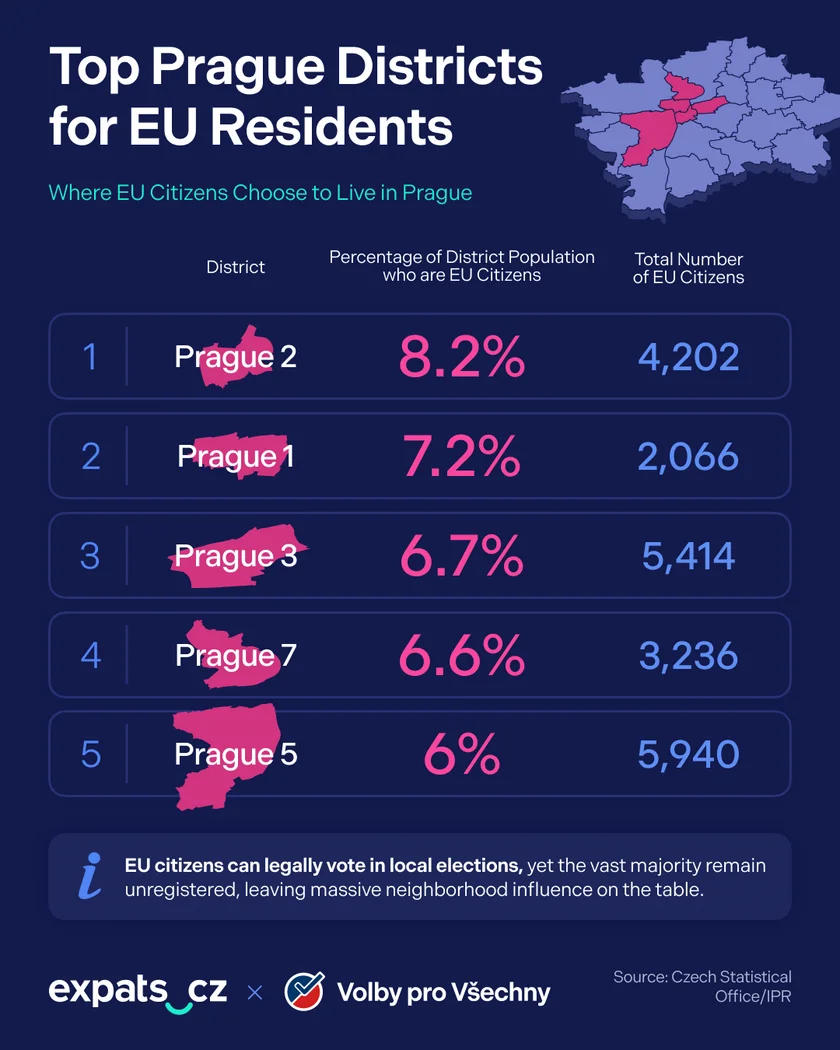
EU citizenship patterns also vary significantly: In Prague 2, about 8.21 percent of adults (over 4,200 people) hold citizenship from another EU country.
Prague 1, 3, 5, and 7 also show relatively high shares of EU nationals compared to the city average. These are not marginal differences. In close local elections, or in community-level decisions, they can matter.
Do the math
In Prague, there are over 42,000 EU citizens who are legally eligible to vote in municipal elections, yet only around 1,800 across the entire city are actually registered. To see what this means in practice, look at Prague 2.
In the last local elections, winning a single seat on the district council required only about 485 votes. Since Prague 2 alone is home to over 4,200 EU nationals, a mobilized community could easily change the outcome.
If just 1,000 extra EU residents in Prague 2 registered and cast their ballots, they would directly control the equivalent of 2 seats on the local council.
These numbers are big enough to sway community-level decisions. But a right unexercised carries no weight. While EU residents naturally shape their neighborhoods through daily life, their formal political influence only comes into existence when they register and vote.

Volby pro Všechny (Elections for All) was founded to help those who aren’t Czech engage with the political system and make their voice heard. Visit their website for more data visualization, voter registry tools and to test your knowledge on how local government works.