 Reading time: 2 minutes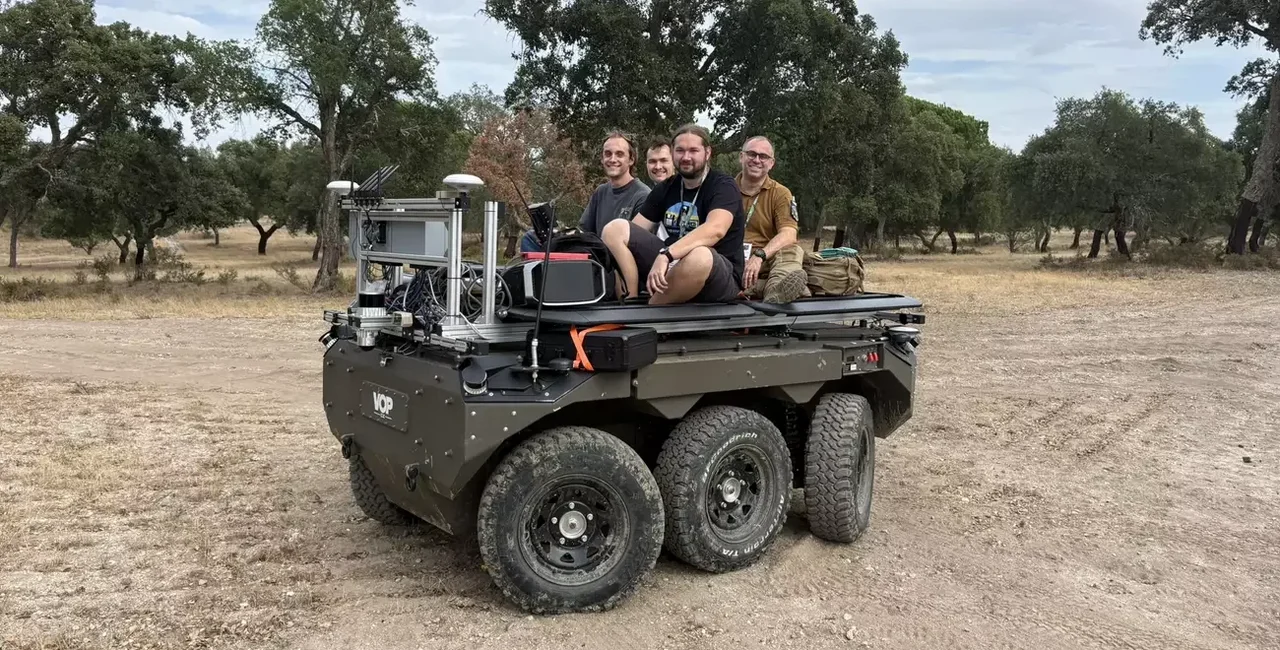

 Summary for: Czech robot TAROS completes autonomous supply missions in Portugal
A Czech robotic vehicle completed autonomous supply missions during a military exercise in Portugal, delivering to forward units while an operator supervised rather than continuously controlled its movement, researchers said Tuesday.
The six-wheeled TAROS platform traveled more than 100 kilometers during ARTEX 2026, including several dozen kilometers autonomously, according to the Faculty of Electrical Engineering at the Czech Technical University in Prague, known as FEL ČVUT.

The tests brought together university researchers, the University of Defence, manufacturer VOP CZ and Czech military personnel. The exercise ran from Sept. 28 to Oct. 9 under a European Defence Agency initiative examining unmanned ground systems.
Operator sets the destination, robot chooses the route
ČVUT researchers are developing autonomous navigation for TAROS, which can carry up to 600 kilograms in the configuration tested.
During the exercise, the vehicle repeatedly completed routes approximately 2.5 to 3 kilometers long, traveling on unpaved tracks and across terrain with dense vegetation and natural obstacles. Autonomous speeds reached up to 8 kilometers per hour, the faculty said.

The operator specifies a destination and, where necessary, intermediate navigation points. The robot then plans its route, using a laser-based LiDAR sensor to map its surroundings, assess terrain and detect obstacles.
Human supervision remains part of the system. When the vehicle identifies a situation it cannot safely navigate, it is designed to stop and allow the operator to take control.
Czech army Capt. Štěpán Konecký said reliability, predictable behavior and cooperation with the operator would be essential to practical use—not simply the ability to complete a route.
The team also tested nighttime navigation. Because LiDAR measures surrounding geometry without relying on daylight, TAROS autonomously covered several hundred meters on and off unpaved tracks after dark.
Supply tests point toward further development
The supply scenarios involved cooperation with the Portuguese army.
In the first mission, an operator remotely controlled TAROS along a paved road shared with cars and trucks. It completed the remaining section autonomously on a parallel, uneven track primarily used by armored vehicles.

All subsequent supply missions were completed autonomously, with the operator primarily supervising, according to the faculty.

A separate test simulated casualty evacuation. A Portuguese army volunteer traveled approximately 2.5 kilometers on a stretcher mounted on TAROS, allowing the team to assess transport comfort and the platform’s suitability. That journey was remotely controlled, rather than autonomous.
Jan Faigl, head of FEL ČVUT’s Computational Robotics Laboratory, said testing outside the laboratory and obtaining feedback from potential military users helped guide development.
Researchers and students from several faculty departments contribute to the navigation system, combining expertise in robotics, control, sensing and computing.
The team will now use the exercise findings to improve autonomous driving, the operator interface and safe operation in difficult terrain. The trials demonstrate progress in a supervised military exercise; the release did not announce an operational deployment or procurement decision.