



 Reading time: 4 minutes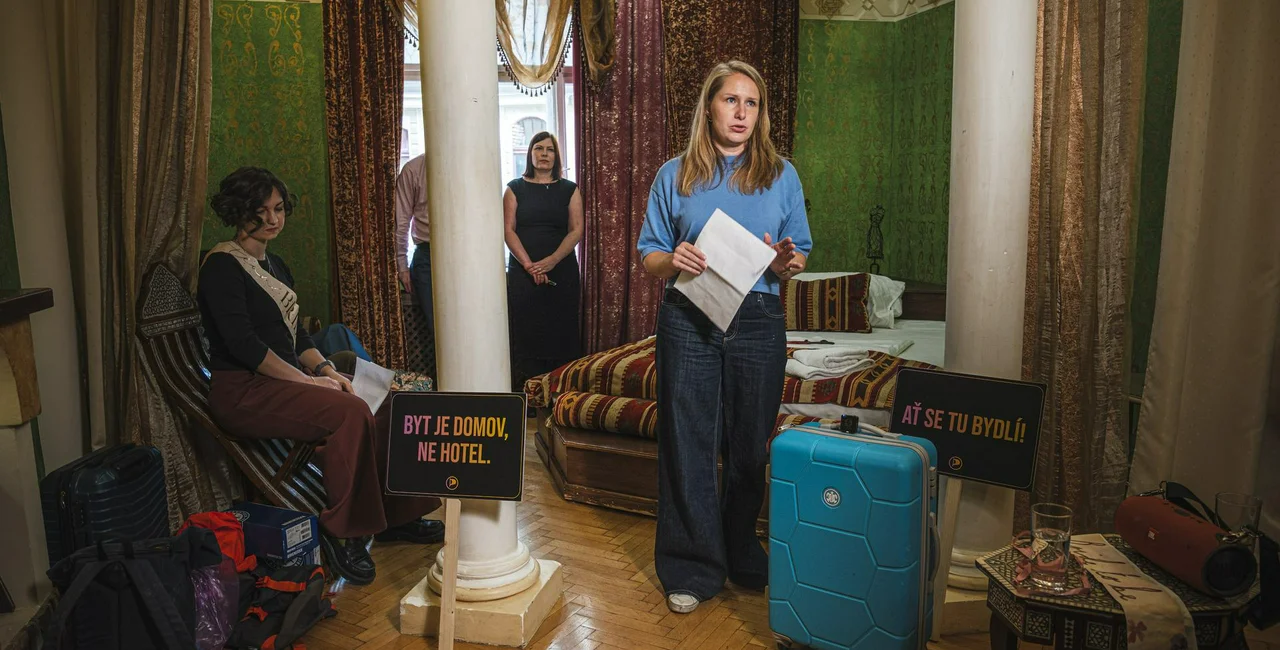

 Summary for: Czech Pirate Party targets Airbnb rentals in surreal Prague election video
Prague’s Pirate Party has turned the city’s short-term rental controversy into an unconventional election video featuring a Moroccan-themed apartment, a “sultan’s bed” and former mayor Zdeněk Hřib wielding bolt cutters.
The party rented an oriental-style apartment on Školská Street through Airbnb to film the social media spot, which promotes stricter enforcement against homes used exclusively as tourist accommodation.
In the video, Pirate candidate for Prague mayor Tereza Nislerová pulls back the covers to reveal Hřib lying in the ornate bed wearing a safety helmet and clicking a pair of cutters. The deliberately absurd presentation has divided viewers but successfully drawn attention to one of the party’s principal housing policies ahead of the Oct. 9–10 municipal elections.
“We chose this format to highlight how extensive and critical the problem of shared accommodation platforms is in Prague,” Nislerová told Novinky.cz.
Pirates distinguish home-sharing from commercial apartments
The Pirates say they are not targeting residents who occasionally rent out their own homes while traveling or students who temporarily sublet their rooms.
Instead, they want enforcement focused on investors and operators who use residential apartments continuously as hotel-style accommodation without complying with construction, licensing and tax rules.
“We do not target owners of individual apartments who follow the rules of the sharing economy, but speculators and platforms that facilitate short-term accommodation by circumventing laws that should apply equally to everyone,” Nislerová said.

The party claims Prague 1 had 5,888 short-term accommodation listings across Airbnb, Booking.com and Vrbo as of Sept. 20, citing data provider AirDNA. The figure excludes listings on some Asian and Russian platforms.
It also cited the Snesitelné bydlení v centru Prahy association, which counted 11,798 tourist beds inside residential buildings in the city center at the end of June. According to the association, only 12 complied fully with the applicable rules.
Those numbers come from the party and advocacy groups and depend on how listings, individual beds and entire apartments are counted. In another campaign statement, the Pirates estimated that at least 10,000 Prague apartments serve tourists, while the press release referred more broadly to around 20,000 short-term accommodation units across the capital.
The party argues that many units have disappeared from the long-term housing market, contributing to the depopulation of central districts while exposing permanent residents to noise, waste and strangers repeatedly entering their buildings.
Prague 1 mayoral candidate Tomáš Raiter accused large commercial operators of violating regulations ranging from construction and business licensing rules to tax and waste obligations. Ellen Anna Kovačíková, a Pirate candidate in Prague 2, said the district found unauthorized accommodation in 14 of 15 buildings selected for a sample check.
These are campaign claims, and the owners or operators concerned were not quoted responding to them.

Higher taxes and stronger enforcement proposed
The Pirates propose multiplying property tax on entire apartment buildings that remain vacant over the long term or are used wholly for tourist accommodation.
They also want accommodation platforms to provide authorities with data that would distinguish genuine home-sharing from apartments effectively operating as hotel rooms.
Nislerová said enforcement against short-term accommodation forms one part of a broader 10-point housing plan. The platform also promises CZK 20 billion for municipal housing and policies intended to raise Prague’s overall construction rate to 10,000 homes annually through a combination of public and private development.
Other proposals include accelerating construction in designated zones, strengthening the Prague Development Company, renovating vacant municipal apartments and ending further sales of the city’s housing stock.
Hřib argued that building new apartments would have less effect if existing homes continued to move from residential use into tourist accommodation.

The Pirates’ previous housing proposals have attracted accusations that the party wants to interfere excessively with private property. Critics particularly seized on an earlier idea to use electricity-meter data to identify apartments that appeared to remain vacant.
Nislerová told Novinky that she and her husband own two connected apartments in Pankrác, where they live with their three children, as well as a smaller apartment rented to a long-term tenant. She said the family has never offered any of its properties through short-term accommodation platforms.
Prague still lacks direct regulatory powers
The practical obstacle is that Prague cannot independently introduce many of the restrictions the Pirates advocate.
Municipal authorities currently rely largely on construction law, business licensing inspections, local accommodation fees and tax enforcement. The party argues that responsibility is divided among offices that lack both sufficient data and direct control by City Hall.
National legislation debated in the Chamber of Deputies would give municipalities greater flexibility to regulate short-term accommodation in residential buildings. Options discussed by lawmakers include limiting the number of rental days per year, setting occupancy limits and introducing restrictions only in heavily affected neighborhoods rather than imposing a blanket ban.

The proposed eTurista system would create a register of accommodation establishments and units, require electronic guest records and help municipalities administer local accommodation fees. The government has presented the platform as a way to identify operators and create more equal conditions between conventional hotels and short-term rentals.
EU rules are also moving toward greater transparency by requiring platforms to share standardized information with public authorities in countries that operate registration systems.
Thousands of Prague apartments are used as short-term tourist accommodation through platforms such as Airbnb. Do you think Prague should introduce stricter rules for short-term rentals?
Until the Czech legal framework grants cities clearer authority, Prague’s ability to impose neighborhood-specific limits will remain restricted. The Pirates are therefore campaigning on two fronts: promising stricter use of powers the city already has while pushing national lawmakers to give municipalities stronger tools.
Whether voters find the ornate bed and theatrical performance persuasive remains to be seen. But the video has succeeded in placing Airbnb—and the question of who Prague’s central apartments are ultimately for—firmly into the final stretch of the municipal campaign.