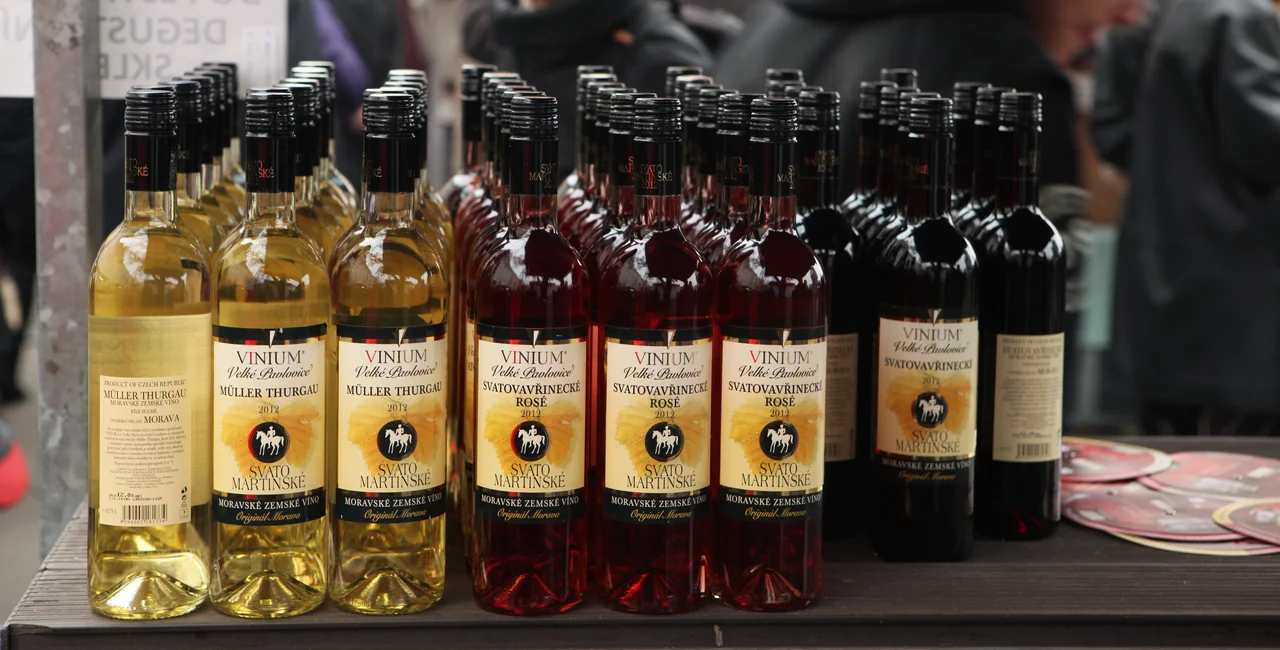
Czechia’s annual St. Martin’s wine celebrations will have fewer bottles to go around this year, with producers preparing 1.6 million bottles under the official Svatomartinské label.
That is 300,000 fewer than last year, a decline of almost 16 percent, following a grape harvest approximately 30 percent smaller, according to the Czech Wine Fund.
PARTNER ARTICLE
The first officially branded wines will be available to taste Nov. 11. Despite the reduced harvest, winemakers report healthy, well-ripened grapes and promising quality, particularly among red varieties.
Fewer wines qualify under stricter rules
This year, 283 wines from 67 wineries earned the right to use the Svatomartinské trademark, compared with 323 wines from 73 producers last year.
The Wine Fund, which has owned the trademark since 2005, awards it annually to young wines that meet requirements covering grape varieties and quality.
An expert tasting panel assesses submissions in two rounds. This year, wines needed at least 82 points out of 100 to qualify, two points more than in 2025.
White wines make up the largest category, with 132 approved wines. The selection also includes 71 rosés, 10 clarets and 70 reds. Müller Thurgau is the most frequently represented grape variety, appearing in 75 wines.
Wine Fund director Zbyněk Vičar described the new vintage as fresh, aromatic and fruity, saying producers had delivered good-quality young wines despite a difficult growing season.
“Svatomartinské wines are traditionally the first opportunity to taste the new vintage,” he said.
Smaller crop brings promise for red wines
Although growers harvested roughly a third fewer grapes than usual, they rated the fruit’s quality highly. Grapes were healthy, well ripened and reached high average sugar levels, according to the Wine Fund’s announcement.
Petr Ptáček, vineyard manager at Bohemia Sekt, said the demanding weather had nevertheless created particularly favorable conditions for red varieties.
“The grapes were smaller, but very well ripened and in excellent health,” he said. Producers consequently expect full-bodied, structured reds with intense color.
Early assessments suggest 2026 could be among the more interesting recent vintages for red wines, Ptáček added. That remains an initial assessment as the season’s wines develop.
For shoppers, the distinction between “young wine” and the official Svatomartinské label matters. Wines made from this year’s grapes may reach shops before Nov. 11, but those without certification cannot be marketed under the protected brand.
The smaller release therefore concerns officially approved Svatomartinské wines, rather than every young Czech wine available this autumn.