
 Reading time: 3 minutes

 Summary for: Rare paintings return to Prague for major exhibition after nearly a century
A nearly four-meter-wide painting that took six people to move is among the artworks arriving in Prague for a major exhibition opening Wednesday, Nov. 4.
For the first time in almost a century, the works of Czech painter Jaroslav Čermák (1830–1878) are being brought together on a major scale, with rare international loans offering visitors a new perspective on one of the country's most internationally successful 19th-century artists.
PARTNER ARTICLE

The exhibition, Jaroslav Čermák: Myths of European Reality, runs until Feb. 28, 2027, at Prague City Gallery's Municipal Library venue in Old Town.
Organized in collaboration with the National Gallery Prague, the retrospective features paintings, portraits, landscapes, and drawings from Czech and international collections, including works rarely displayed in Czechia.
A Czech painter who made his name in Paris
Born in Prague in 1830, Čermák built a career that extended far beyond his homeland. He studied in Prague, Antwerp, and Brussels before establishing himself in Paris, then the center of the European art world.
His paintings appeared at prestigious Paris Salons, attracting wealthy collectors and earning recognition in France and Belgium.
But much of his artistic inspiration came from further southeast.
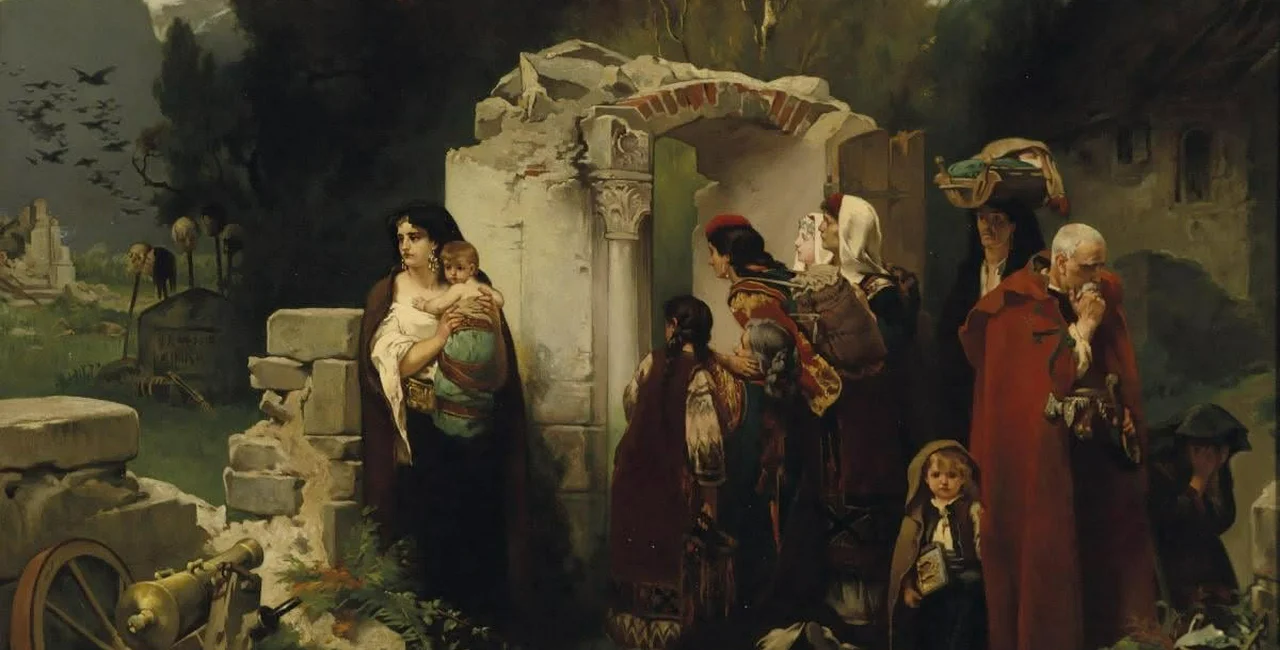
Traveling through the Balkans, Čermák became fascinated by the region's struggles for independence from the Ottoman Empire. His dramatic paintings frequently depicted wounded soldiers, displaced families, and women caught in conflict.

According to Prague City Gallery's announcement, the exhibition explores how these subjects reflected both the political tensions of the 19th century and the expectations of European audiences.
Among the highlights is Spoils of War, an enormous 1868 painting on loan from the Royal Museums of Fine Arts of Belgium in Brussels.
The work, which measures nearly four meters across, won a gold medal at the Paris Salon and was later purchased by the Belgian state.
Visitors will also encounter The Wounded Montenegrin (1873), on loan from Zagreb, alongside a monumental unfinished composition depicting captive Herzegovinian women.
The latter survives as a charcoal drawing on canvas measuring more than five meters wide. Čermák died in 1878 before completing the painting.
Rare international loans and new discoveries
The retrospective brings together works from institutions including the Louvre in Paris, the Royal Museum of Fine Arts Antwerp, Amsterdam Museum, and the National Gallery Prague, which has contributed 53 loans.
Beyond displaying the paintings, curators are examining how Čermák developed his international reputation, from his Paris studio to the art dealers who circulated reproductions of his work across Europe.
The exhibition also considers how his depictions of Balkan subjects combined sympathy for people affected by conflict with the exoticized imagery popular among Western European audiences.
Several years of research and conservation work preceded the exhibition, with 17 conservators involved in preparing the artworks and their historical frames.
That research has even overturned a long-standing attribution: a painting titled Golgotha, previously believed to be by Čermák, has been identified as the work of another artist.
Rather than excluding it, curators have included the painting to demonstrate how art historians investigate questions of authorship.
The exhibition also features an interactive studio for children and families, where visitors can create compositions inspired by Čermák's paintings.
How to visit the exhibition
Jaroslav Čermák: Myths of European Reality is on display at GHMP Knihovna, on the second floor of the Municipal Library building at Mariánské náměstí 98/1 in Prague 1.
The exhibition runs from Nov. 4, 2026, through Feb. 28, 2027.
Opening hours are Tuesday through Sunday, 10 a.m. to 6 p.m., with extended hours until 8 p.m. on Thursdays. The gallery is closed on Mondays.
Standard admission costs CZK 200, with reduced tickets available for students, seniors, and children. Family admission costs CZK 450.
Tickets are available through GoOut or at Prague City Gallery ticket offices. Further information about visiting, guided tours, and accompanying activities is available on the gallery's official website.
For visitors interested in Czech art history, the exhibition offers a rare opportunity to see how a Prague-born painter established himself on the international stage, and how his work connected the artistic and political worlds of 19th-century Europe.