



 Reading time: 2 minutes

 Summary for: UNESCO advises restoring, not replacing, historic Prague railway bridge
In a new advisory report, UNESCO's World Heritage Centre and the International Council on Monuments and Sites (ICOMOS) recommend the restoration of Prague’s historic Vyšehrad Railway Bridge rather than its replacement. The Czech Ministry of Culture has confirmed receiving the report.
The recommendation follows a mission to Prague in December, where UNESCO experts reviewed plans by the Czech Railway Administration to replace the bridge with a new structure.

Plans to replace the bridge, a significant piece of Prague's architectural heritage, face criticism from local communities and preservationists, who argue that such a move would undermine the city’s World Heritage status.
UNESCO's recommendation: preservation over replacement
The UNESCO report emphasizes that restoring the Vyšehrad Railway Bridge would be the most appropriate solution, both in terms of preserving Prague’s World Heritage status and minimizing environmental impact.
The bridge, a crucial transportation link since its opening in 1872, is currently in poor condition due to corrosion, limiting its capacity. However, UNESCO highlights the importance of the bridge’s architectural value and recommends that a renovation, rather than a replacement, would best serve both heritage conservation and public transportation needs.
Experts suggest that a restoration would not only maintain the bridge’s structural integrity but also allow for minimal changes to its steelwork.
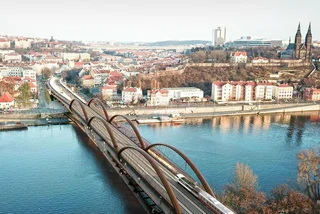
The report also outlines that the recommended restoration could be carried out in approximately four years, with minimal disruption to train operations. This contrasts with the construction of a new bridge, which would be more expensive and take significantly longer.

Balancing progress and heritage
The debate surrounding the Vyšehrad Railway Bridge reflects broader tensions between modernization and historical preservation in Prague. The bridge's replacement proposal was initially driven by the need to increase railway capacity, with the addition of a third track.
However, UNESCO's report, highlighted by the Czech Ministry of Culture, calls for careful consideration of the bridge’s cultural significance and warns against undermining Prague's position on the World Heritage list.
Transport Minister Kupka has stated that the ministry will review the UNESCO recommendations and the results of a forthcoming heritage impact assessment (HIA). The HIA, which is expected by July 2025, will play a key role in determining the future of the project.

In the meantime, work continues on preparatory tasks, including the relocation of utilities, though the final decision will depend heavily on the HIA’s findings.
The dispute has raised concerns among heritage organizations and local politicians, with some warning that replacing the bridge could jeopardize Prague's World Heritage status. Advocates for the bridge’s preservation have also raised concerns about proposals to move the bridge upstream, arguing that this would eliminate its original function and compromise Prague's scenic skyline.