



 Reading time: 6 minutes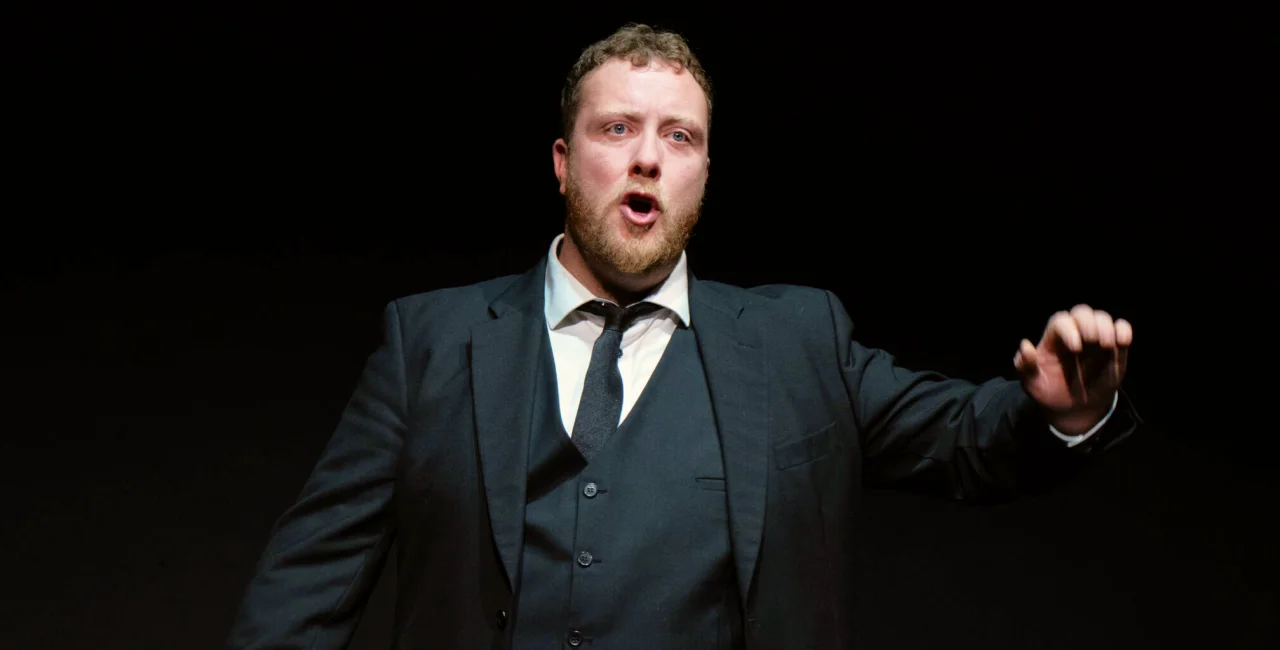

 Summary for: Irish theater hits Prague with a Traveller wake, a wily housekeeper, and a glossary
Ireland is a small country with an outsized theatrical tradition. From Beckett to Martin McDonagh, its playwrights have long had a habit of finding the universal in the parish, pub, kitchen, wake. This spring, Prague gets this tradition in duplicate.
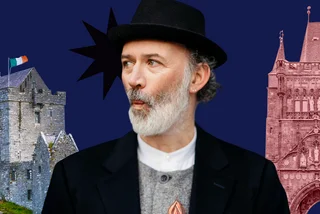
First comes The Dead House (March 11 at Divadlo Na Pradle), a one-man show written and performed by Martin Beanz Warde, a stand-up and actor whose debut received four stars from the Irish Times.

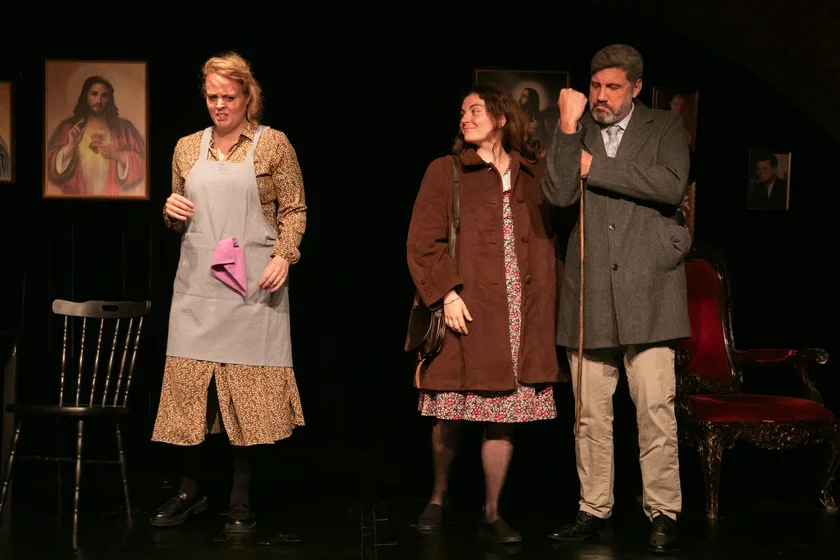
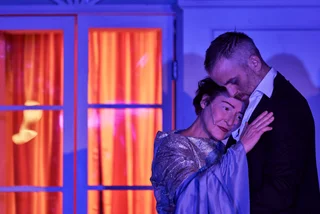
Next up, Moll, (March 14 at Divadlo D21), John B. Keane's 1971 comedy about a wily housekeeper who runs rings around the hierarchy of the Catholic church, presented by Cultúr Slovensko, the company behind a sold-out run in Bratislava last November.
The two plays may share an island and a language, but the similarities end there. One is a boisterous ensemble comedy; the other is an emotional solo performance.
But the same themes resurface in both. Speaking to Expats.cz, The Dead House playwright Warde and Oscar Brophy, who plays the Bishop in Moll, reflected on the Irish tendency to employ humor in the face of adversity, and the question of how Czech audiences will take to its native theater.
On language, and making the audience a little more Irish
Both productions are performed in English; but not quite the English spoken in Prague. Hiberno-English, as Brophy explains, is the dialect shaped by centuries of Gaelic grammar and vocabulary bleeding into the colonizer's tongue. It is not so broad as to be impenetrable, but it is specific enough that a glossary helps.
"We weren't expecting people in Bratislava to know what we meant when we said words like 'yoke' and 'boreen'," he says.
Moll, written in the West of Ireland at a time when the Catholic church was an inescapable social fact, also assumes a passing familiarity with ecclesiastical hierarchy that modern Central European audiences may not share. The company has prepared a printed glossary for the Prague production to address both.
But Brophy, who has lived in Slovakia for a decade, sees this not as a barrier to cross so much as an invitation to extend.
"For myself and a lot of Irish people living abroad, one of the best things about connecting with other Irish people is slipping back into our shared slang," he says. "By educating people in that slang, we're making the audience a little more Irish, purely by exposure."
Warde, whose play deals in the specific world of Irish Traveller customs, approaches the language question with more pragmatism and a characteristic self-deprecating wit.
He intends to make small adjustments for international audiences (performances are also planned in Vienna, Bratislava, Budapest, Zagreb, Belgrade, Sarajevo, and Dubrovnik), swapping the Irish word for police, Gardaí, for its English equivalent; slowing the pace in places where his character rattles.
"The silent moments will be deliberate," he adds. "But not for any clever playwright reasons. I'm not that clever. Yet."
On grief that laughs because it has to
John B. Keane was among the great comic writers of 20th-century Ireland, and Moll is among his most beloved plays precisely because it holds nothing sacred. The proof of its universality, says Brophy, came in Bratislava.

"The moments we were expecting to get laughs all landed uproariously." The comedy, he insists, needs no adjustment for export. "This play is for anyone who understands English and likes to laugh."
In The Dead House, the mood is darker and so is the comedy. Warde's protagonist, a young Irish Traveller attending his grandfather's wake, uses humor the way many Irish men do: as a way of not saying the thing that needs saying.
"The comedy in the play isn't at the expense of the grief," Warde says. "It is actually a symptom of it. Patrick uses humor to deflect from the emotions within, a trait familiar to most men from hyper-masculine and traditionally religious communities."
Ireland and Central Europe: Closer than you think
The most striking moment in either conversation comes when both men are asked how the Irish experience maps onto the Central European one. In both cases, the comparison leads to the same institution: the Catholic church.

"My personal feeling is that the influence exerted by the Catholic church over Irish social and cultural life in the 20th century was somewhat analogous to the Czechoslovak experience of repressive communism, though the main target of Ireland's repression was women and girls," says Brophy.
He adds: "I guess the main difference is that we could get away with writing plays that made fun of the system."
Warde sees the parallels as more direct. The Dead House, he says, is "basically the Czech version of Dům smutku (the House of Mourning)." He is genuinely curious to see whether Prague audiences will feel the recognition. "I'm very eager to see if Czech audiences see the similarities, because they are there."
On Irish identity
Both plays carry the weight of community representation, though in very different registers. Brophy, who has lived outside Ireland for a decade, speaks of Moll in terms of cultural ambassadorship.
"We are a cultural powerhouse whose influence far outstrips the size of our population," he says. The international cast assembled by Cultúr Slovensko, under director John Fagan, only deepens that sense.

For Warde, himself an Irish Traveller, the question of who the play speaks for is more politically charged. The Dead House is explicitly a play about a Traveller, and Warde is aware of the misconceptions that label carries.
"We're not the Travellers you read about," his character Patrick says at one point, a line that lands differently depending on what you've read. But Warde's larger argument is one of inclusion: "Irish Travellers are merely a microcosm of Irish society."
More diverse audiences, he adds, may find themselves connecting with parts of the play that others pass over. A subplot speaks to sexuality in communities where masculinity is performative. In the final act, Patrick confronts his past traumas, one of which involved his first love.
"Patrick's sexuality isn't foregrounded mainly because love isn't a sexuality," he says. "It is a human emotion and a connection."
Rituals and rule breakers
Asked for a piece of Central European literature that holds a candle culturally to Moll, Brophy references Peter Pišťanek's Rivers of Babylon, the cult Slovak novel that follows a hotel boiler-room stoker's darkly comic ascent through the Bratislava underworld during the Velvet Revolution.

"It's a great deal darker," he says, "but the underhanded means by which the main character advances mirrors the actions of Moll herself." Both works also find their comedy in characters who win by refusing to play by the rules everyone else pretends to follow.
Warde, meanwhile, promises no similarities but an introduction of sorts. The Dead House will be many Prague audience members' first encounter with both an Irish wake and Traveller culture.
He expects some unfamiliarity, but says that ultimately grief is the manifestation of the loss of love; it's just the way we observe it that sets us apart. Warde believes it's in these moments that the audience will see themselves.
With grief, letting go of the daily reminders can be tougher than letting go of the body, no matter how simple the keepsake. -From the Dead House
"Irish Travellers have held on to older Irish customs a little longer, mixed with a few of our own traditions. If we look at the Irish wake back in the 80s, we would remember the gendered roles, the emotionally stunted men, the alcohol, the grief, and sandwiches at 11 in the morning."
The Dead House, written and performed by Martin Beanz Warde, comes to Divadlo Na Prádle, Prague, on March 11, 2026. Tickets here.
John B. Keane's Moll, presented by Cultúr Slovensko, directed by John Fagan, comes to Divadlo D21 on March 14, 2026. Tickets here.