




 Reading time: 4 minutes

 Summary for: Czech salaries are rising, but these workers are pulling ahead in 2026
Salaries across Czechia are continuing to rise in 2026, but the days of employers handing out similar increases across the board may be fading.
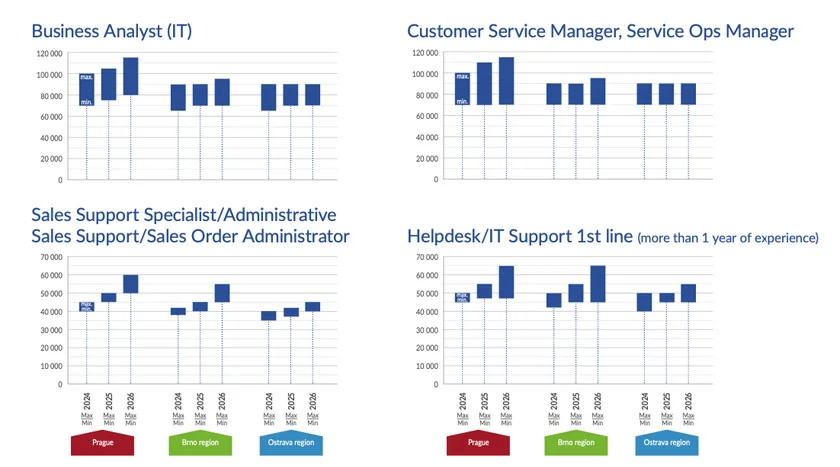
Pay has typically increased by 4 to 6 percent year on year across most sectors and regions, according to a new salary survey from recruitment agencies Grafton Recruitment and Gi Group. But companies are increasingly directing bigger raises, bonuses and other incentives toward workers they consider particularly valuable or difficult to replace.
Experienced technical specialists are among those in the strongest position. Employers are also increasingly looking for people who can combine their traditional expertise with data, automation, artificial intelligence and other digital tools.
For jobseekers, meanwhile, salary alone is no longer the only deciding factor. Flexibility, commute time, professional development and working conditions are playing a growing role in whether candidates accept an offer.
The survey covers more than 350 positions across nine major sectors and is primarily based on starting salaries offered to candidates placed by the two agencies and employers' hiring requirements during the second quarter of 2026.

Who is in demand—and who faces more competition?
Despite rising unemployment and a larger pool of available workers, employers are not necessarily finding it easier to recruit.
Companies can receive dozens of applications for jobs in administration, HR, marketing and some junior positions. Qualified technicians, engineers, automation specialists, experienced finance professionals and technology experts, however, remain much harder to find.

That divide is increasingly visible for recent graduates. Technical graduates, particularly those in mechanical and electrical engineering, have relatively strong prospects. Competition is much greater in administration, customer service, marketing and HR.
Employers are also raising expectations for entry-level hires as technology reduces the need for some routine and junior roles.
"Young people who gained practical experience while studying, speak foreign languages and know how to work with digital technologies, including AI tools, have a major advantage," Grafton Recruitment and Gi Group director Martin Malo said.
IT offers a striking example. There are fewer vacancies than in previous years and salary growth has slowed, while demand is concentrated on enterprise architects, senior testers and cloud and cybersecurity experts. Automation is also reducing demand for some junior and general development positions.

Similar changes are spreading far beyond the technology sector. Finance employers increasingly want candidates who understand both financial processes and data; manufacturers need automation and analytics skills; and marketers are expected to work with AI, campaign automation and data.

The survey says demand is falling for some creative positions, including graphic designers and copywriters, as companies increasingly adopt digital and AI tools.
Foreign workers remain vital to Czech employers
Location continues to make a significant difference to both salaries and job opportunities.
Prague and Central Bohemia retain the country's highest salaries, while the Karlovy Vary region's average gross wage is 14 percent below the national average, according to the survey.
Competition for qualified employees is particularly strong in Prague, Central Bohemia and South Moravia. Employers there are increasingly looking beyond traditional recruitment pools, including foreign workers, parents returning from parental leave and people over 55.

Foreign labor has become especially important in manufacturing, construction, logistics and health care.

The report says some Czech manufacturers would struggle to operate without international workers, with recruitment from the Philippines becoming increasingly common. Logistics companies rely heavily on employees from Ukraine, Serbia and Asian countries, while Slovak and Ukrainian workers help fill shortages in Czech health care.
Employers are also attempting to attract a wider range of workers with shorter hours and more flexible arrangements, though Czechia continues to lag behind much of Europe in part-time employment.
More than 514,000 people in Czechia worked part time at the end of 2025, representing roughly 10 percent of employment, according to figures cited in the report. The European average exceeds 17 percent.

Salary isn't everything anymore
For workers considering a new job, pay remains the biggest factor—but employers increasingly need to offer more than a higher number on a contract.
Malo said candidates look closely at flexibility, working hours, workplace environment and opportunities for career development. Commutes are also a major consideration, with candidates ideally looking to keep travel time below 30 minutes.

Remote work remains particularly important in IT, where candidates are paying close attention as some employers reduce the number of home-office days available.
In manufacturing and logistics, where remote work is generally impossible, employers are instead using shift bonuses, transport allowances and recruitment bonuses to make jobs more attractive. Workers are increasingly favoring one- or two-shift operations over more demanding schedules.
The broader trend means workers with scarce skills remain in a strong negotiating position even as parts of the Czech labor market become more competitive.

And the definition of a scarce skill is changing. Rather than simply looking for an IT specialist, accountant, engineer or marketer, employers increasingly want people who can combine their core profession with technology, data and AI.
"Technological skills have long since stopped being the domain of IT," Malo said. "For employees, this means the need to continuously expand their competencies, while for companies it means a greater emphasis on developing and retraining their own people."