In our new ‘Artists of Prague’ series, Expats.cz sits down with the creative souls of Prague to understand – from painters and illustrators to musicians and writers – what it takes to make it as an artist in Prague and bring one's aesthetic dreams to life.
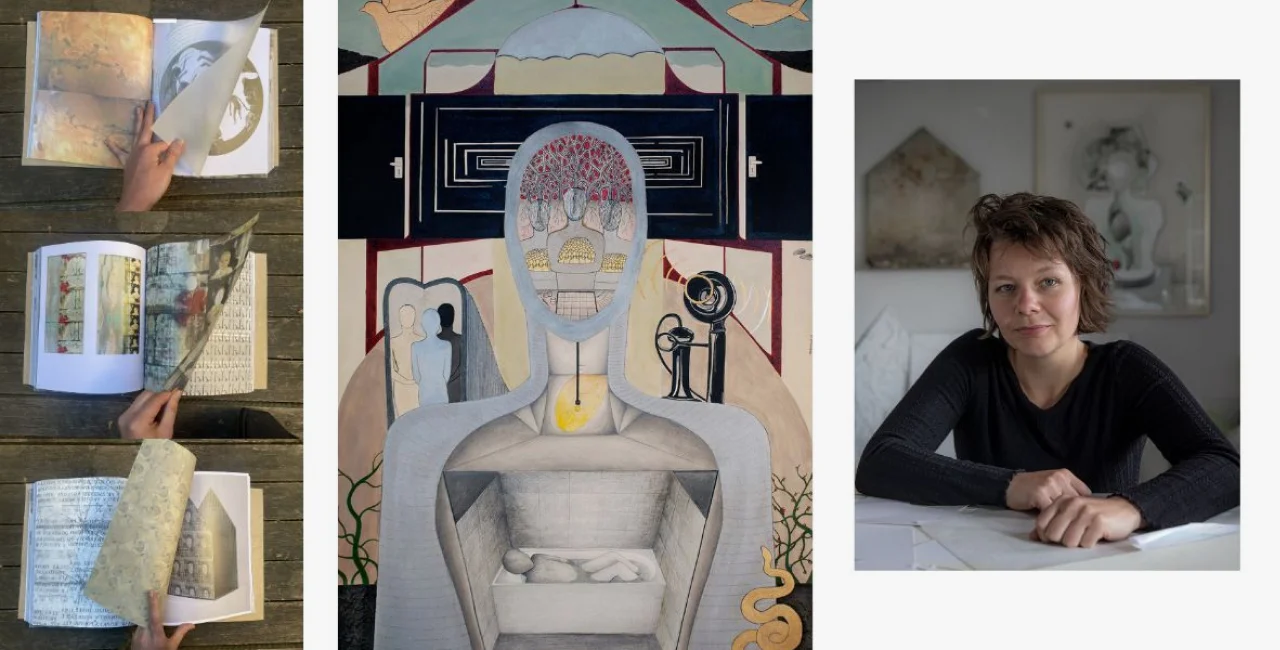
On November 30, self-taught artist Phila Pastor will celebrate the culmination of more than a decade of artistic exploration with the launch of three interconnected projects at Kampus Hybernská, where she currently has her studio.
PARTNER ARTICLE
Her journey towards this point, however, has been anything but conventional.
Born in 1991 in Düsseldorf from a Czech father and a German American mother, Phila quickly moved to the Czech Republic as a small child but found little solace in the local school system – ending up bouncing between half a dozen elementary schools and as many secondary schools.
She would eventually drop out of the educational system entirely.
Lost in the system
Since she was little, she often felt a nagging feeling of not truly belonging, linked to her own cultural background and the various environments she grew up in.
“I have a German passport but can’t speak German. I grew up in Průhonice, on the outskirts of Prague, but at the time felt more American than Czech,” Phila tells us as we meet in her local Letná café. She also mentions having lived for a full year in Minneapolis around the age of 15 – a stay that ended badly.
“I was always very creative, but was blocked by the Czech school system,” Phila says, suggesting the stiff and rigid methods still in place back then might have been a legacy of communism and Normalization.
“I repeated the first year of high school three times at three different schools. By the time I was 18, I didn’t want to hear about school anymore.”
From Paris to India
A scholarship took her to a graphic design school in Jihlava, but that also ended quickly. “It was a very spontaneous decision, I never called the school, I simply stopped showing up and never looked back."
She packed her bags to visit one of her close friends, Jeanne, in Paris before making her way to the southern French city of Arles, famed for its annual summer photography festival.
In a spur-of-the-moment decision, the two young women – who had barely turned 18 – left for India. Jeanne soon had to go back, but Phila stayed behind.
Alone and with very little knowledge of the country, she stayed there several months, travelling to off-the-beaten-path places, learning new instruments and crafts, photographing everything around her, or staying with farmers who didn’t know a word of English.
“I was very open to whatever came my way. Perhaps that openness and the absence of expectations were precisely the ingredients that allowed so many unexpected miraculous things to happen,” she says as she recalls her time in India.
Art in Bohnice
But that state of grace didn’t last. Now back in the Czech Republic, Phila’s future once again started looking gloom, threatening and uncertain – a lost cause for many.
“No one in my family knew what to do with me. I felt frustrated and disconnected and rejected the Czech or any other system for that matter,” she confides. “I was very disagreeable and felt trapped, like time was slipping through my fingers.”
Now aged 22, she ended up in the Bohnice Psychiatric Hospital – a humbling stay far from the pressures of daily life that sparked her creative spirit and taught her to let go of expectations and accept things as they were.
“I really started creating in Bohnice, drawing and painting released the creative blockage I'd been feeling up until now. It was kind of like art therapy, I was using ink, watercolor, aquarelle, pencil, whatever materials were available.”
Say my name
Out of Bohnice, Phila continued working nonstop, experimenting with new techniques, enjoying the creative process itself and not caring about the outcome or result. But while the inspiration was flowing, breaking through on Prague’s art scene was an ordeal.
With no art diploma and a deep dislike for the subtleties of networking, Phila struggled to make a name for herself, quite literally. Her surname at the time was Primus, from her father, which she changed just recently to Pastor as a way to honor her mother Suzanne's maiden name.
“‘Phila Primus’ sounds like a pseudonym, a made-up name that felt extremely unusual and almost fictional to me,” she self-reflects.
Then came the double-edged legacy from her well-connected father, an art historian, curator and professor, and mother, a well-known photographer who co-founded the Prague House of Photography back in the 1990s.
“It was an asset of course, as I was exposed to the artistic environment from an early age and had certain connections; on the other hand, I sometimes felt people were suspicious of my background or unsure whether my work was being recognized on its own merits,” she says.
Imposter’s syndrome
“I was very shy about reaching out to galleries to exhibit my work, I didn’t have enough courage, felt like I had a weird name and background. I felt like an imposter,” she explains, adding that she also always tried to stay clear from the egos, self-congratulatory pats on the back and overall cliquishness of the local art scene.
When things did work out, “I was often overly grateful and agreeable towards anyone who paid attention to me or showed interest in my work - sometimes accepting conditions that I should have questioned," she admits.
Throughout her 20’s, Phila did manage to get her works exhibited in various Prague galleries. But now with a daughter to care for, she had to find a more stable source of income and for years worked as a teacher - mostly art and English - for preschoolers.
The irony isn't lost on her. After spending much of her childhood struggling with the educational system, she eventually ended up working within it herself.
She spent seven years in various schools and innovative educational environments which, contrary to the rigidity she experienced as a child, made room for creativity, independence and collaboration, finally making sense to both her and the children.
As her 30th birthday approached, she felt she had paid her debt to the educational system and could finally close that chapter of her life to devote herself entirely to art.
She invested her last savings into preparing an exhibition of approximately 30 ambitious glass words, organized with a curator who had hosted her first exhibition more than ten years earlier.
The eureka moment
"But the experience turned out to be extremely disappointing. I felt disrespected throughout the preparation and eventually cancelled the exhibition at the very last moment," she says.
The stakes were as high as they could get, but for Phila, that was a make-or-break moment.
She packed everything and walked out, fair and square, turned off her phone, and went home. "I suddenly found myself without a job, almost penniless, with a child to provide for and no immediate prospects," she reflects. That could have been the moment when she called it quits.
She didn’t. “I had an enlightened moment right there and then. That moment when I said ‘no’ is when I stopped caring what people think or how the system works,” she says. “It was almost paradoxical: the thing I had feared most had happened, and suddenly I felt free. Somehow, I knew that everything would be ok.”
Two friends came by to see how she was doing after hearing of the cancelled exhibition. “I was in the best mood I’d ever been. They looked at me like I was crazy,” she laughs.
Success at Hanspaulka
Phila’s optimism turned out premonitory. Through a connection who owned the place, she put together an even larger exhibition in an empty villa in Prague’s Hanspaulka district.
“So many people came, people from the art scene, people from politics, some of whom still support my work to this day, even my dentist came and bought two pieces,” Phila says, still bewildered at the unexpected success and the diversity of people who came to support the exhibition.
“I earned almost half a million Czech crowns within two weeks,” she says, before musing: “And money gives you guts, it gives you confidence.”
Equipped with this newfound assurance, she cold called the head curator of Kampus Hybernská, a prominent art and cultural center next to Náměstí Republiky.
“Hello, I’m Phila Primus and would like to hold an exhibition in your space,” she told Filip Kazda who, as it turned out, used to teach art therapy in Bohnice at the same time as her own stay there, and had been following her work with interest ever since.
Planets were aligning, and the world responded to her leap of faith in the unknown. “I knew now that I was always going to do art and began trusting my own decisions and taking initiative rather than waiting for recognition or permission,” she tells us.
The artist and the child
That was four years ago. Phila first set up shop at the former monastery of Gabriel Loci where she had her studio residency and now as a resident at Kampus Hybernská, and has since been able to live fully from her art.
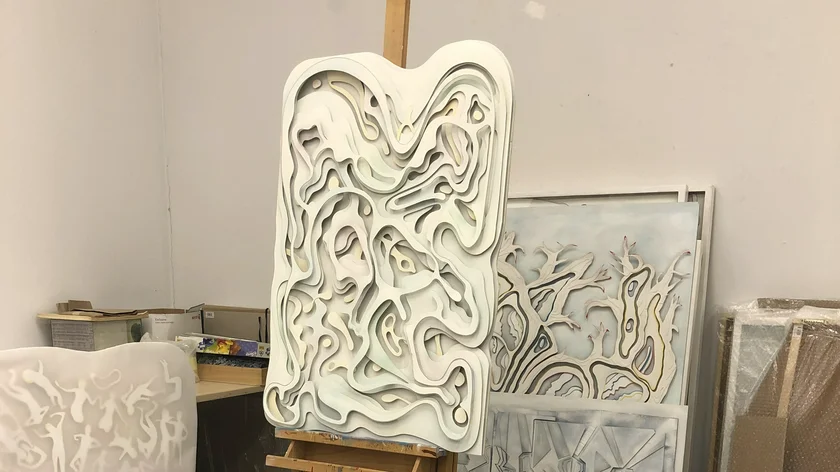
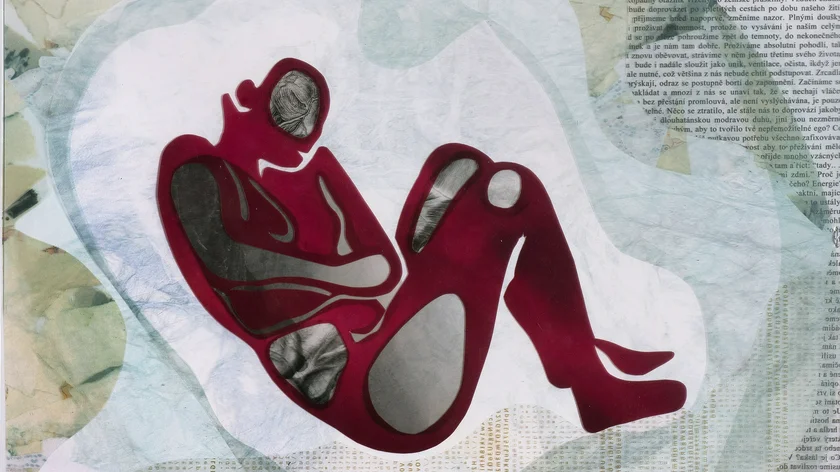
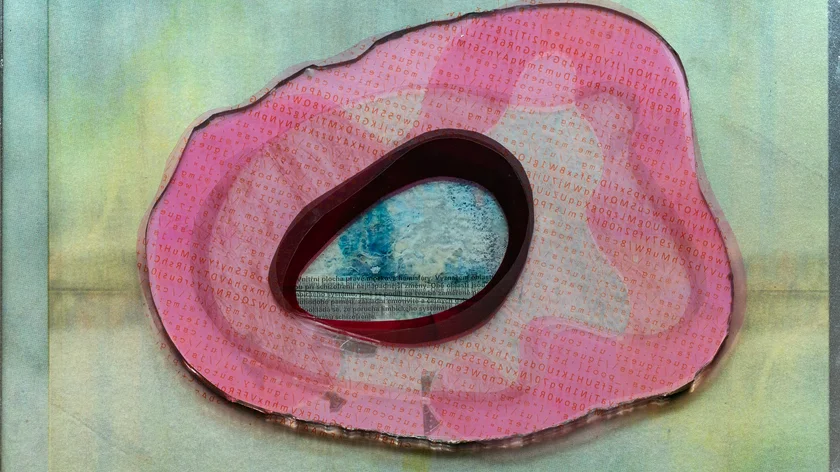
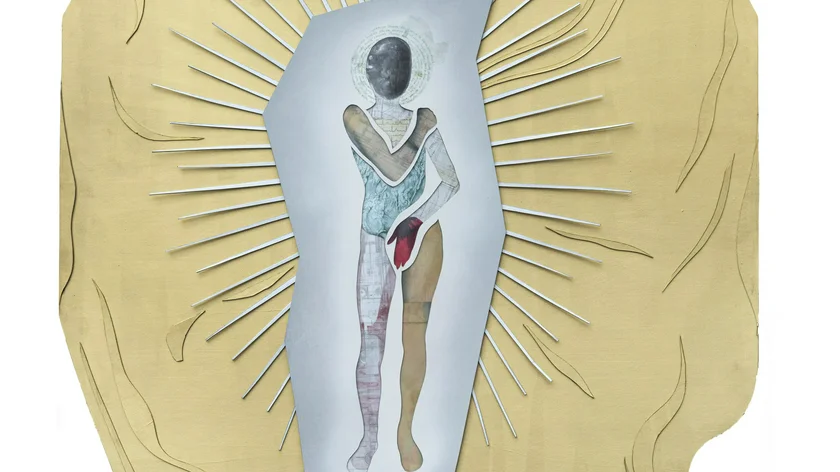
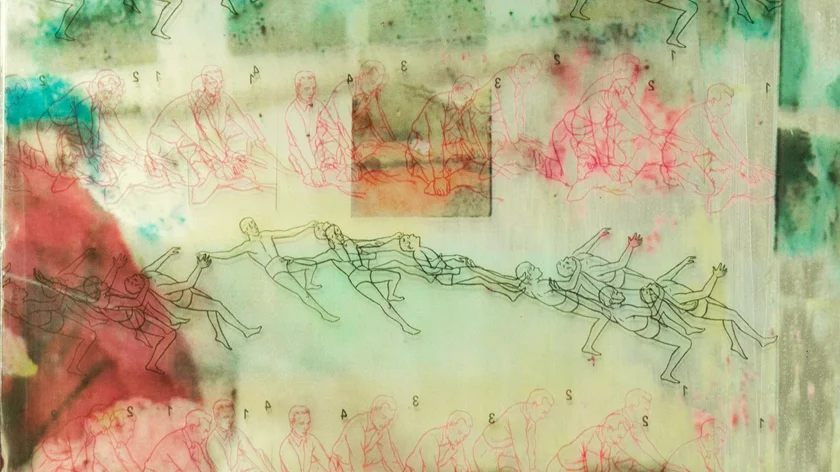
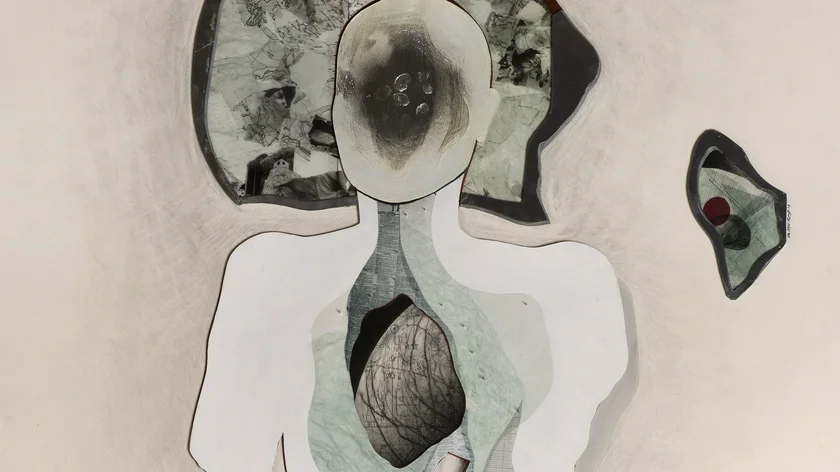
Largely self-taught, she tends to create at the intersection of disciplines – somewhere in between visual arts, poetry, sound and music – and explores the connections between disciplines, often bringing together seemingly unrelated materials, forms, techniques and ideas.
Years of experimentation developed into the visual language she works with today: layering, collecting materials, combining different elements and building compositions through accumulated traces and fragments.
She is now launching three interconnected projects: the art book Phila Pastor - Works 2013-2026; Gatherings, a collaborative music album created with composer Ian Mikyska using sounds generated through the creative process itself; and Disappearing Skin, a bilingual Czech-English poetry collection.
As our conversation draws to a close, she looks back on what she learned along the way. “On paper, I’m really stupid,” she says candidly. “But I don’t care how much or how little I know, I just jump in and learn along the way. Everything can grow out of courage and sensitivity, and from overcoming that fear of ignorance.”
And this, according to Phila, is what it’s all about. “Magic happens when you’re ignorant like a child and can perceive the world always with fresh and excited eyes.”
For more, you can follow Phila on her Instagram page and check out her upcoming event at Kampus Hybernska on November 30.