 Reading time: 3 minutes

 Summary for: Czechia's Week of Science opens its doors – in English and for everyone
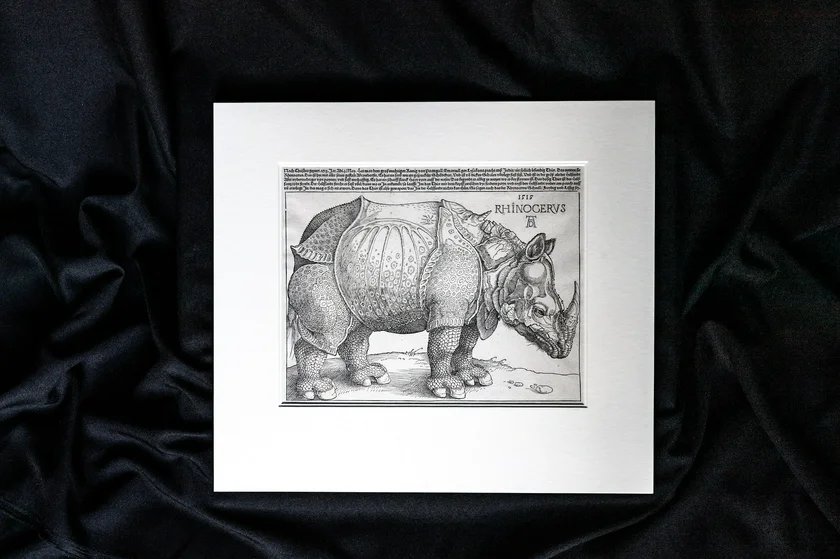
The Week of the Czech Academy of Sciences opened Monday with a Renaissance-era surprise: the unveiling of Albrecht Dürer's Rhinoceros, a first-edition woodcut from 1515 that had been quietly sitting in the Academy’s library collection, its true value unrecognized for decades.
The 245-by-311-millimeter print – one of only a handful of first editions worldwide, alongside those held by the British Museum and New York’s Metropolitan Museum of Art was authenticated just last year when researchers noticed its watermark during a public lecture. The discovery itself embodies the festival’s core mission: making hidden knowledge accessible.
"If we want the public to understand the work of scientists, we must let them see behind the scenes," said Radomír Pánek, President of the Czech Academy of Sciences, at Monday’s opening ceremony at the Academy's headquarters on Národní 3 in Prague.
A week of discovery for all
That behind-the-scenes access continues through Nov. 9, with over 300 free events spanning 22 cities across the country. The fifth annual festival opens laboratories, archives, wind tunnels, and observatories to visitors of all ages, guided by the researchers who work there.
For English-speaking visitors, this year’s programming reflects genuine international integration rather than token translation.
Topics range from a walking tour tracing philosopher Bernard Bolzano’s footsteps through Prague's Old Town to panel discussions on Taiwanese identity, Uyghur persecution in China, and the economic integration of refugees in Europe.
"The core of the festival lies in visits to the Academy’s institutes, where visitors can immerse themselves in science in its authentic environment," Pánek said.

From ancient math to modern fusion
The English-language slate includes accessible introductions to complex topics: Einstein’s gravitational waves and black holes, Archimedes’ ancient calculation of π, and how artificial intelligence is transforming historical research. A documentary screening explores nuclear fusion and the ITER project.
At the same time, hands-on lab visits and open-door days at the Institute of Organic Chemistry and Biochemistry allow students and families to participate in interactive workshops and hands-on experiments.
The festival also marks the 300th anniversary of Vivaldi's Four Seasons with a dedicated lecture, and invites visitors to handle a Nobel Prize medal and see Masaryk’s personal effects.
The rhinoceros that started it all
As for Dürer’s Rhinoceros, the print depicts an animal the artist never actually saw. Working only from a sketch and description sent from Lisbon in 1515, when a live rhinoceros arrived as a gift to King Manuel I, Dürer created what became an iconic image across five centuries.

"The author’s intention was scientific, but at the same time popularizing," said Sylva Dobalová from the Institute of Art History, who authenticated the work. "To inform as many people as possible about this event as quickly as possible."
The parallel to Science Week is intentional: whether communicating the appearance of an exotic animal in the 16th century or the mechanics of gravitational waves today, the goal remains the same, translating knowledge into language everyone can understand.
Admission to all festival events is free, though some require advance reservation. The complete program, including English-language events, is available at www.avcr.cz.
Suggested English-friendly events
A Walk through Bolzano’s Prague (Nov. 4, Prague 1) – Guided tour tracing philosopher Bernard Bolzano’s life and legacy.
The Future of the Past: AI and Historical Research (Nov. 5, Prague 6) – How artificial intelligence is changing historical study.
Archimedes’ Calculation of π (Nov. 6–7, Prague 1) – Lecture on ancient math methods that outlasted centuries.
Einstein Gravity, Gravitational Waves, and Black Holes (Nov. 3–7, Prague 1) – Accessible introduction to Einstein’s theory and new discoveries.
The Economic Integration of Refugees (Nov. 6, Prague 1) – Talk on refugee employment and policy solutions in Europe.
“Let There Be Light” Film Screening (Nov. 7–8, Prague 8) – U.S. documentary on nuclear fusion and the ITER project (English audio, Czech subtitles).