 Reading time: 6 minutes

 Summary for: Prague’s English papers folded decades ago. These students are betting on print again
The first stack of 80 copies fresh off the press went quickly.
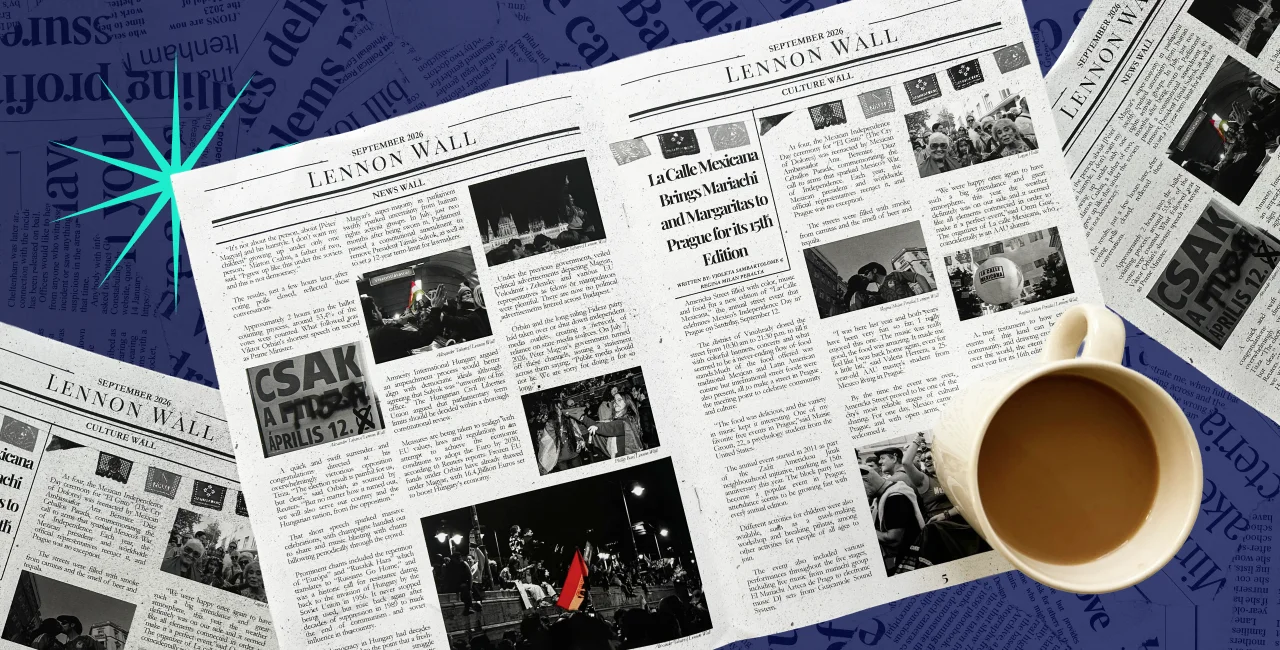
Last semester, The Lennon Wall, Anglo-American University’s student newspaper, relaunched as a standard print. Within a short span of time, all of their copies were sold out, seen in the hands of students at the Café Des Taxis as everyone rushed to complete the series of crossword puzzles featured on the back page.
PARTNER ARTICLE

This October, its co-editors put out the latest edition. Sales were not as successful this semester, but the group is pressing on, convinced that a paper you can physically hold possesses significant value in a city where English-language news exists almost entirely online.
And they aren’t the first group of youth to bet on it either. For more than two decades, Prague’s English speakers consumed their news on paper, starting in the early 1990s with a handful of California natives and a monthly called Prognosis launching in 1991.
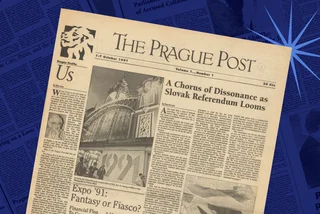
This Autumn, the city's past returns: the same month The Lennon Wall sold its second edition, The Prague Post, the most successful English-language newspaper the city has ever seen, opened its digital archives to the public.
Meet the students putting news back on paper
The Lennon Wall is run by three student co-editors-in-chief – Alexander Tabares, Jackson Gillies, and Phillip Ban – all studying journalism at the university.
The trio agreed that as The Lennon Wall continues to grow within the school, they wanted to rebrand themselves into a proper newspaper. Previous editions have been released, but this time they wanted to really emphasize the traditional newspaper, drawing inspiration for the format from The New York Times and The New Yorker.

When asked whether the group felt print journalism could make a revival in the Prague community, Gillies responded, “I think that one of the reasons why it’s kind of an uphill battle for print to make a revival is that people just don’t read anymore.”
This, he suggests, might have led to a decline in revenue for The Lennon Wall. The co-editors stated that they were not satisfied with the results of sales this semester because last semester, when they released their first re-branded edition, they sold all 80 printed copies. This semester, out of 100 copies printed, they only sold about 40.
That wasn’t always the case for English speakers in Prague. Decades ago, English-language press curated nearly all of the information that expats needed to know in a standard newspaper, and just about everyone read it.
The 1990's gold rush for English news
Taking a look back at the early 90s, Prague was in a unique environment of artistic production following the end of the Velvet Revolution in 1989. With this came an influx of expats, specifically those who spoke English. Among the masses came a small group of 20-somethings from California, who shared a dream of starting the first English-language newspaper in Prague.
And so, in March of 1991, Prognosis was born. Prognosis was a monthly publication that lasted until 1995. The group had its fair share of highs and lows, and in the end, it never made any profit. Despite its challenges, it was a notable moment in Prague’s journalistic history.
Prognosis was not the only English-language print publication to form in Prague. In October of 1991, following a disagreement between members of the Prognosis team, two individuals took their leave of the business and began their own, and with that came The Prague Post. This found much more success, releasing print editions until 2013 before finally filing for bankruptcy in 2016. Since October 2026, The Prague Post has been making its publications accessible to the public through its digital archive.
The zines that did it differently
Mark Baker, an independent travel writer and journalist who is an expat himself and has been living in Prague for approximately 25 years now, says that the most interesting thing about these English-print presses is that none of them lasted. Contrary to the standard newspapers, there was an alternative form of English journalism founded in Prague during the early 90s, and that was the zine scene.
The publication Velvet, making its debut in 1995, is considered one of the first English-language magazines according to Baker, and with that came an abundance of cultural magazines, journals, and zines.
“(The zines) were much freer to create something out of nothing, and they reflected the style of the founder or the idea of the founder, but they also more broadly reflected the outlines of the expatriate community at that time somehow,” says Baker.
The zine scene met a similar fate to that of its standard newspaper companions; however, it never truly disappeared from Prague and can be found in different forms lingering about in bookshops such as indie mainstay PageFive in Letná.


Into the early 2000s, the printers began to cool. Then came the digital era, where technology served to bridge that gap in information.
The ink runs dry
As technology began to advance, the press began to regress. Contrary to the immense amount of information available throughout the web today, that wasn’t the case when Martin Howlings, CEO and founder of Expats.cz arrived in Prague.
Howlings, originally from Milton Keynes in the United Kingdom, arrived in Prague in 2000, where he said the creative atmosphere was still alive and well with print, but the attention began to shift toward technology.

“If you wanted to understand Czech politics or find out what was happening culturally, there were publications that could help you,” he says. “But if you needed to find an apartment, understand a visa procedure, locate a particular service, or get practical advice from someone who had already experienced the same problem, the information was much more fragmented.”
With this realization came the birth of Expats.cz. The online platform was designed to create a trusted connection between the community and provide the necessary information to thrive, as well as support the businesses that served it.

“We started as a community platform, developed into a major information resource, and subsequently expanded into professional journalism,” says Howlings.
The current status of Expats.cz has exceeded the expectations of its founder and CEO, taking a simple idea and turning it into a significant opportunity and responsibility.
Although the internet now gives society unfettered access to information, some believe that newspapers are still necessary.
Students with a vision
For now, the AAU students are undeterred. With club funding from the university, The Lennon Wall plans to keep printing, and Ban, for one, sees the format as more than nostalgia.
“There is a power in print media that is not allowed to be neglected because of that AI slop,” Ban says.
Tabares is already expanding his idea beyond the walls of campus. He wants the paper to evolve into something closer to a neighborhood publication, placed in the hands of more than just AAU students.

“My intention is to make it like a Malá Strana paper,” he says. “I really like the idea of small papers for different communities in a city.”
It’s an idea Prague is familiar with. Thirty years ago, the city’s zines were scrappy, sometimes absurd, and intimate. Today, 80 copies at a time, a few students are betting that small is the key to print's survival.
The students at The Lennon Wall will continue to release a paper each month, beginning to utilize club funding issued by the school to expand on what they have developed. You can find issues at American-Anglo University.