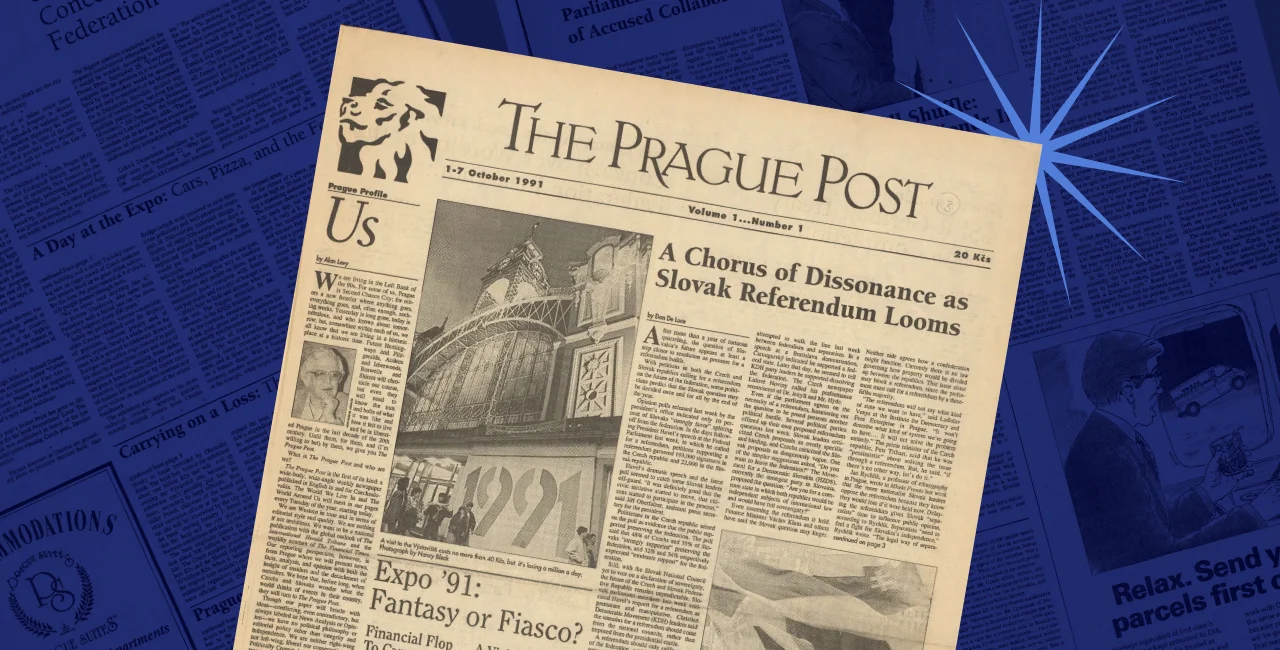
Before smartphones, social media, and English-language city apps, newcomers to Prague learned about their adopted home through the pages of The Prague Post.
The weekly newspaper covered politics, business, culture, nightlife, and the practical complications of living in a country changing almost by the day. Its pages documented the split of Czechoslovakia, the emergence of a market economy, and Prague’s transformation into an international capital.
Now, 35 years after its debut, those pages are returning through a new searchable digital archive at praguepost.org.
The archive launched Thursday, Oct. 1, with a complete digital copy of the newspaper’s first issue, originally published on the same date in 1991.
Readers can follow Prague’s transformation week by week
Rather than releasing the entire archive at once, organizers plan to publish one issue each week—the edition that appeared during the corresponding week 35 years earlier.
The schedule will allow readers to experience events in roughly the same order as the paper’s original audience, following the political, economic, and cultural upheavals of the early 1990s in something approaching real time.
Each issue will be browsable and text-searchable, making it possible to look up people, businesses, events, restaurants, political developments, and aspects of everyday Prague life that may otherwise have disappeared from the internet.
Issues published between 1991 and 1994 have already been scanned and processed. Approximately two more decades remain to be digitized.
The archive is administered by Modrá sova, a nonprofit English-language library and learning center in Loužnice, a village in the Jizera Mountains where the original newspaper collection is housed.
Modrá sova has independently funded the digitization work so far and is inviting organizations, former readers, and other supporters to contribute through donation links on the archive website. Researchers can also request individual article lookups or arrange to consult the physical collection in person.
A newspaper for a city reinventing itself
The Prague Post was founded in 1991 by Lisa Frankenberg, Kent Hawryluk, and investor Monroe Luther. American journalist Alan Levy, who had witnessed the 1968 Warsaw Pact invasion and written about it in So Many Heroes, served as its founding editor-in-chief.
Produced from a small office near Old Town Square, the debut edition ran to 12 pages and combined news and business reporting with cultural listings and a pub guide.
Levy captured the mood of the period in the newspaper’s first issue, declaring: “We are living in the Left Bank of the ’90s.”
The description reflected the mythology surrounding post-revolution Prague: a relatively affordable, rapidly changing city attracting writers, artists, entrepreneurs, teachers, and young travelers from around the world.
The paper was not Prague’s first post-communist English-language publication. Prognosis, where several of its founders had previously worked, began publishing earlier in 1991. But The Prague Post outlasted its contemporaries and developed into Czechia’s longest-running English-language weekly.
Its intended audience extended beyond expatriates. Czech readers used it to follow domestic developments from an international perspective, while travelers relied on its restaurant reviews, event listings, and practical coverage.
The newspaper also became a training ground for journalists who later worked for international organizations including Bloomberg, AFP, The New York Times, Variety, and the Australian Broadcasting Corporation. Its design won repeated recognition at the European Newspaper Awards.
The Prague Post has returned through a new digital archive, 35 years after its first issue was published. Did you ever read the newspaper during its original run?
After 22 years, The Prague Post ended its weekly print edition in July 2013 and continued publishing online. Operations ceased amid insolvency proceedings in 2016.
The new archive is not a revival of the newspaper itself. Instead, it preserves a record of a distinctive period when both Prague and its international community were finding new identities—and when a weekly broadsheet helped them make sense of the changes together.