 Reading time: 2 minutes

 Summary for: Czech photographer’s stunning Sky Eye wins US weather photo contest
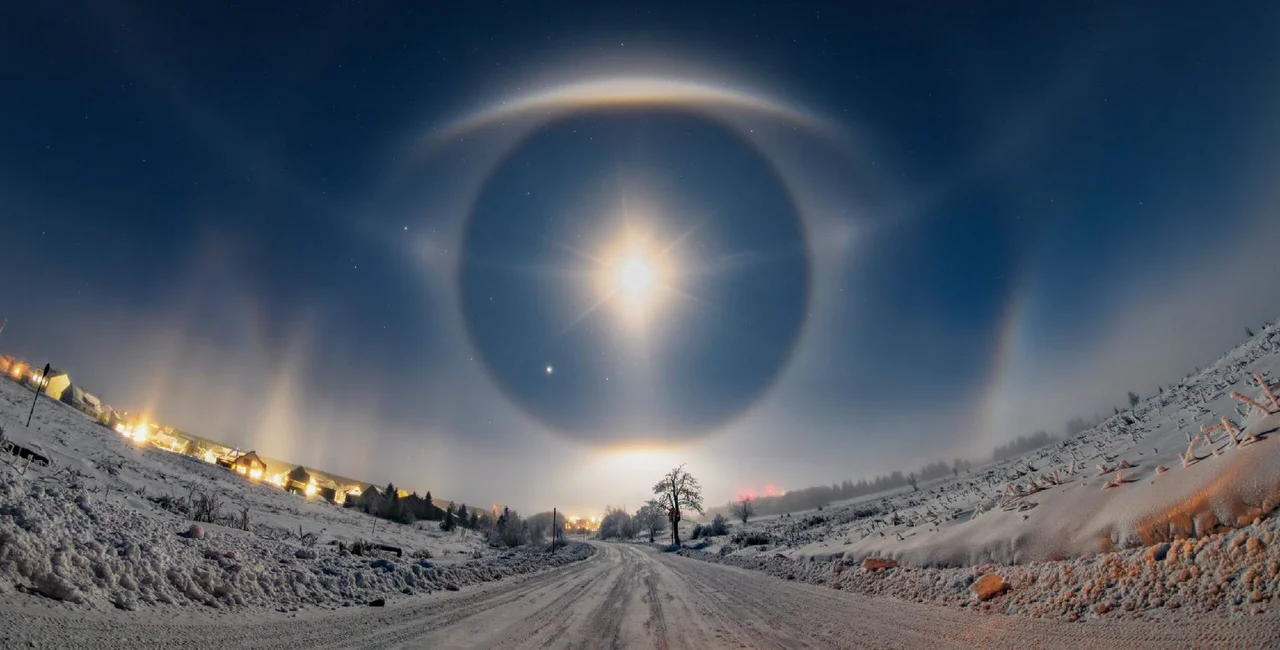
A vast luminous eye appears to watch over a snowy road in the Ore Mountains. At its center is the nearly full moon, surrounded by intersecting rings and arcs of light.
The photograph, Diamond Dust Sky Eye by Czech photographer Jaroslav Fous, has won the grand prize in the American Meteorological Society’s 2026 photography competition, which received 1,075 submissions from photographers across 84 countries.
Taken near Boží Dar on Dec. 13, 2024, the image captures an unusual combination of atmospheric optical phenomena. Getting the shot required several hours in freezing conditions, and a friend’s suggestion to stay until dark.
A cold afternoon becomes a remarkable night
Fous had already been photographing halos around the sun before the moonlit display developed.
“The photo Diamond Dust Sky Eye was taken after a sunny, frosty day with daylight halos. I was there for three hours, and made many photos of daylight halos," he told the AMS.
"My friend wrote me to wait until the night for moon halos. It was about -7°C, with humidity about 97% and a gentle breeze. The moon was about 95% (two days before full moon). The photo was taken in the Ore Mountains near Boží Dar in Czechia (Czech Republic).”
He used a Nikon D500 camera with a Samyang 8mm fisheye lens and a tripod.

The “diamond dust” in the title refers to tiny ice crystals suspended in the air. Moonlight passing through or reflecting from those crystals produces halos, with their shapes determined by the crystals’ geometry and orientation.
The photograph includes a prominent 22-degree halo, tangent arcs and bright spots known as moon dogs. Together, the formations create the impression of an enormous eye above the landscape.
Fous told Novinky.cz that snowmaking equipment was operating at the nearby Neklid ski area. Under suitable conditions, snow machines can contribute ice crystals that help produce such displays near ground level.
A Czech image with international recognition
The AMS award adds to an already notable record for the photograph.
NASA selected it as its Astronomy Picture of the Day on Dec. 25, 2024. It subsequently placed third in the Royal Meteorological Society’s 2025 photography competition.

AMS announced this year’s winners Oct. 19, with judges selecting three prize-winning images and society members choosing a separate favorite.
Second place went to Chris Elkinton’s Sea Dragon, showing colliding waves at Cape Disappointment on the Washington coast. A fleeting formation in the spray resembles a dragon rising from the sea.
Roberto Bueno took third with Cirrus, the Veils of the Moon, a black-and-white photograph of delicate clouds beside a crescent moon, taken from Spain’s Mediterranean coast.
Jeremy Janus won the Members’ Choice award for Rainbow Cataclysm, capturing a rainbow beneath mammatus clouds east of Denver.
All four winning photographs, alongside the finalists, can be viewed in the official AMS competition gallery.