


 Reading time: 3 minutes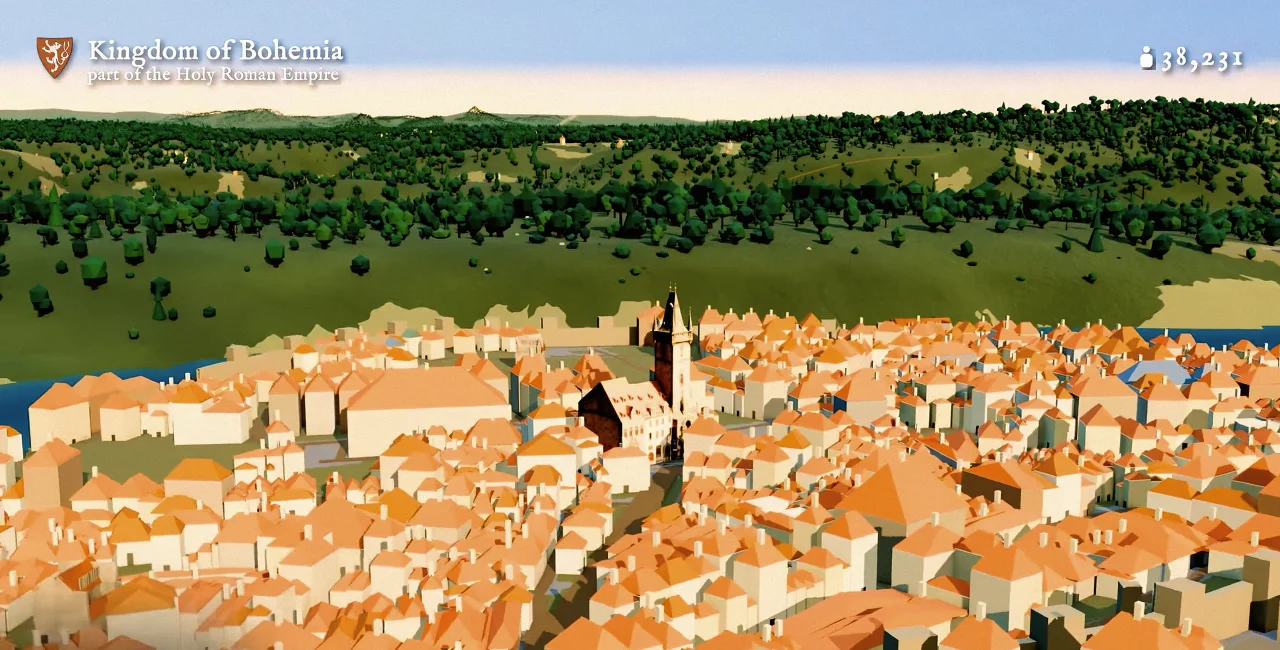

 Summary for: WATCH: Prague grows through 2,000 years of history in a new 3D timelapse
Before the spires, tram lines, and apartment blocks, there is a wooded landscape threaded by the Vltava. Then settlements appear, bridges cross the river, and a recognizable Prague gradually takes shape.
A video from YouTube channel Latos Charts compresses more than 2,000 years of that transformation into roughly 12 minutes. Created using Blender, the 3D animation follows the area from the second century B.C. to 2026, combining a changing cityscape with captions about buildings, battles, and moments of upheaval.
For anyone accustomed to navigating Prague at street level, the aerial perspective offers a different way to understand it. The historic center emerges as a collection of neighboring settlements, while districts that now seem inseparable from the capital spread across what were once open fields.
From riverside settlements to Charles IV’s capital
The Latos Charts video opens in the territory of the Boii, the Celtic people associated with the name Bohemia. These ancient scenes serve as a reconstruction of the area before the medieval city, rather than a depiction of Prague as we know it.
As the timeline advances, fortified sites and clusters of buildings begin to organize the landscape. The Vltava river remains a strong visual anchor: settlements grow along its banks, and crossings draw the two sides closer together.
One of the clearest changes in the history of medieval Prague came with Charles IV’s establishment of New Town in 1348. A substantial addition was added beside the older settlement, helping explain why central Prague has several historic identities. Old Town, New Town, Malá Strana, and Hradčany remained separate towns until their unification in 1784.
Charles Bridge then takes shape across the Vltava. Construction began in 1357, replacing the Judith Bridge, which had been badly damaged by flooding in 1342. Watching the crossing emerge emphasizes its practical role in connecting the city, before it became a destination in its own right.

The video also brings viewers closer to familiar landmarks, including the astronomical clock and the twin towers of the Church of Our Lady before Týn. Its captions mix historical milestones with folklore, identifying the story about eggs in Charles Bridge’s mortar as a legend.
But the medieval sequence is far from a peaceful architectural tour. The 1419 defenestration and the Hussite conflict interrupt the city’s growth. At Vítkov in 1420, the animation depicts defenders resisting a crusading force, placing a major episode of Czech history within a landscape today surrounded by urban neighborhoods.
Wars, expanding neighborhoods, and a familiar skyline
Later centuries bring further confrontations. The video depicts the Prussian bombardment of 1757 and the suppression of Prague’s 1848 uprising, with military formations and smoke interrupting the otherwise steady spread of buildings.
The removal of fortifications provides another striking transition. As walls disappear, development extends into surrounding land, and the compact historic core becomes part of a much larger city. New bridges and railway infrastructure further reshape the view.
Petřín Tower adds a recognizable landmark to the hillside. Built for the Jubilee Exhibition in 1891 and inspired by the Eiffel Tower, it appears as part of Prague’s changing late-19th-century skyline.

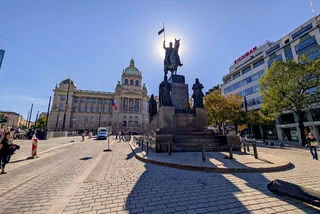
The political labels change alongside the buildings, carrying viewers through Czechoslovakia, Nazi occupation, communist rule, and the Czech Republic. A 1968 sequence focuses on Soviet troops firing at the National Museum; traces of that damage were deliberately preserved during the building’s restoration.
The Dancing House, completed in 1996, brings the riverside into the postcommunist era. A 2002 flood sequence shows water spreading beyond the Vltava into the streets, recalling a disaster that also inundated parts of the metro.
By 2026, the opening landscape has become a sprawling capital. The animation’s strongest effect is the connection it makes between familiar places and the successive layers of growth, destruction, and rebuilding that produced them. A bridge, a hillside tower, or a museum facade becomes a marker in a much longer story.