 Reading time: 3 minutes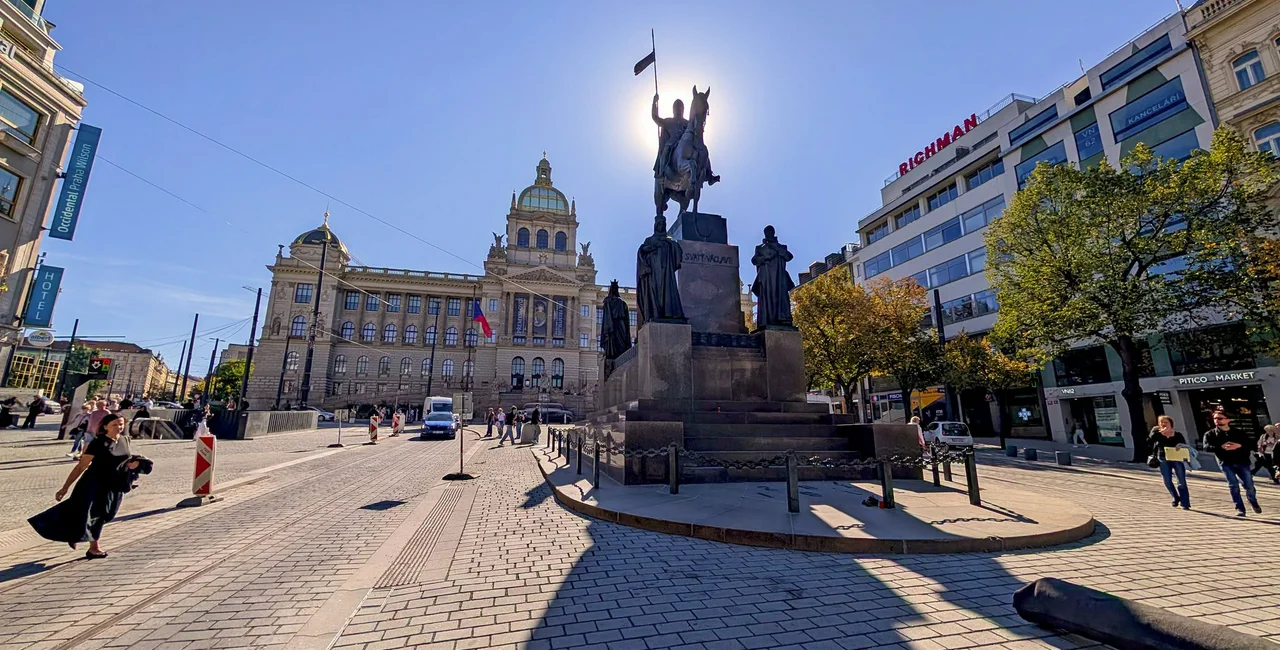

 Summary for: Rails return: Wenceslas Square tram tracks reconnect Prague after 46 years
For the first time in 46 years, tram rails once again form a continuous route along Prague’s Wenceslas Square.
Workers have connected both tracks between the existing Jindřišská–Vodičkova line and the National Museum, marking a symbolic milestone in the transformation of one of Prague’s most prominent public spaces.
The route is not yet ready for trams. Construction fences remain in place, concrete is still curing in some sections and the overhead electrical lines have not been installed. Regular passenger service is scheduled to begin at the end of June 2027.
A controversial decision finally reversed
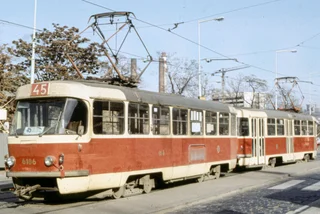
Trams last traveled lengthwise along Wenceslas Square on Dec. 13, 1980. The route was abolished more than two years after the opening of metro line A and its Můstek and Muzeum stations.
Although the rails remained in place until 1982, trams subsequently crossed the square only between Jindřišská and Vodičkova streets.
Prague Integrated Transport described the 1980 closure as a “great Prague transport mistake” in a social media update announcing the restored tracks.
The new double-track line begins at the existing intersection near the center of the square and continues uphill toward the statue of St. Wenceslas. From there, it connects with tracks around the National Museum and branches toward Vinohradská and Škrétova streets.

The adjoining Muzeum section was completed nearly six months ahead of schedule in September. Lines 11 and 13 have already resumed service between I. P. Pavlova, Muzeum and Vinohradská, but the link down Wenceslas Square will remain closed until the wider reconstruction is finished.
When it opens, the route will create an alternative north-south connection through central Prague and give the tram network another option when service is disrupted around Václavské náměstí, Lazarská or nearby streets.
What the rebuilt square will look like
The tracks are only one part of a broader redesign intended to reduce the square’s emphasis on cars and create more room for pedestrians.
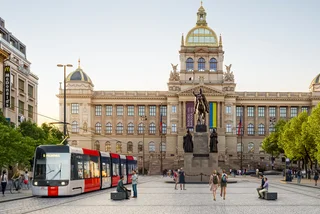
Instead of running together through its center, the two tracks are separated by a wide pedestrian area. Trams and cars will share two corridors along the sides of the square, with each corridor carrying traffic in one direction.
The layout allows the central promenade to remain the square’s main public space while avoiding a conventional tram corridor through the middle.

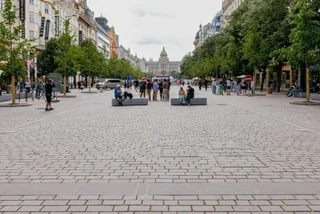
The first completed sections near the St. Wenceslas statue show how much additional space pedestrians will receive. Former traffic lanes and parking areas are being converted into wider sidewalks, restaurant terraces, parallel parking spaces and a second avenue of trees.
The number of trees in the upper part of the square is expected to double. A new rainwater-management system will help irrigate the greenery, while Prague mosaic paving will unify the pedestrian areas.
New combined lamp and traction poles are being installed within the tree line. Between the statue and the Jindřišská–Vodičkova intersection, arms extending from those poles will support the overhead wires, reducing the need for cables stretched across the width of the square.
Two new stops and a wider metro entrance
The reconstruction will add tram stops at two points along the new line.
The future Václavské náměstí stop near the Jindřišská–Vodičkova intersection will serve trams traveling between the existing east-west route and the National Museum. Tracks have been installed to allow trams to turn both toward Jindřišská and Vodičkova.

A second stop named Muzeum is taking shape below the St. Wenceslas statue, close to the upper end of the square.
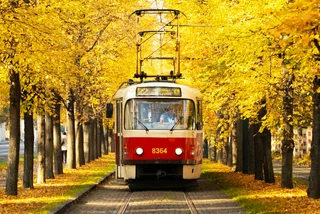
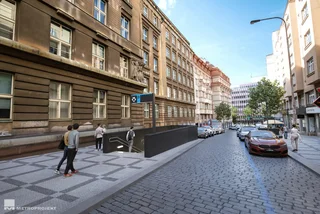
Between the lower pair of stops, workers are also building a wider central entrance to Můstek metro station. It will replace two smaller side entrances removed to make room for the redesigned transport corridors.
Construction has been deliberately divided into sections so shops, hotels and restaurants remain accessible. In several areas, vehicles have temporarily been moved onto completed portions of the tram corridor while former road lanes are rebuilt as sidewalks and landscaped spaces.
That phased approach explains why some portions already have finished paving while others remain behind fences.
Trams return in June 2027
The restored rails make the final layout easier to picture, but significant work remains. Crews must complete surrounding roads and sidewalks, install overhead wiring, finish both stops and open the new Můstek entrance.

Trams will return to Wenceslas Square in June 2027, nearly 47 years after regular service ended. Do you think bringing them back is a good idea?
The first passenger trams are scheduled to run along the complete Wenceslas Square–Muzeum route at the end of June 2027.
The Prague Public Transit Company provides construction updates, maps and the latest schedule on its official project page.