Could the distant roots of the Irish language lead back to somewhere near Prague?
It is an intriguing possibility behind a story circulating on social media: research suggesting that the expansion of Celtic languages may have involved populations connected to what is now Czechia.
The scientific paper is real, published in the journal Nature on Nov. 4. But the claim that researchers have pinpointed what is now Czechia as the birthplace of Irish needs some qualification. The findings offer a new perspective on a much older European connection, and a reason to look again at Bohemia’s Celtic heritage.
A Bronze Age clue near Prague
In “Tracing the spread of Celtic languages using ancient genomics,” Hugh McColl and colleagues analyzed genome-wide data from 4,587 ancient individuals to investigate competing explanations for Celtic expansion.
Their preferred explanation involves populations moving westward from eastern Central Europe during the late Bronze Age, roughly 1200–800 BCE. The researchers connect this movement with ancestry associated with the Knovíz–Urnfield cultural world.
For Czech readers, Knovíz is of particular interest: the archaeological culture takes its name from a village near Slaný, northwest of Prague. However, the authors explicitly use “Knovíz-related ancestry” as a proxy for a broader population, rather than identifying people specifically belonging to that culture.
The findings strengthen a Central European explanation for the spread of Celtic languages. They do not establish a precise birthplace for Irish or prove that its ancestral speakers traveled directly from Bohemia to Ireland.
There is also a fundamental limitation: DNA reveals ancestry, not speech. Population movements can help explain how languages spread, but people can adopt another language without a corresponding change in their genetic ancestry.
Irish and Celtic are not interchangeable
Irish belongs to the Celtic language family, alongside Scottish Gaelic, Manx, Welsh, Cornish and Breton. These are related languages with their own histories, rather than interchangeable versions of a single tongue.
According to Ireland’s Gaeltacht development authority, Údarás na Gaeltachta, the oldest surviving evidence of ancient Irish consists of ogham inscriptions dating to the fifth and sixth centuries CE. Writing in the Roman alphabet followed before the beginning of the seventh century.
Those inscriptions belong to a world considerably later than the Bronze Age migrations under discussion. A possible explanation for the movement of ancestral Celtic languages is therefore different from identifying the moment Irish itself emerged.
Modern national labels can also obscure the story. Describing prehistoric populations as “Czech” or “Irish” projects today’s identities onto people who lived long before either country existed.
The more useful question is how communities, languages and ideas traveled across a continent whose present borders would have meant nothing to them.
Bohemia’s Celtic past is closer than you think
Whatever conclusions emerge from the linguistic debate, Bohemia’s place in the later Celtic world is supported by substantial archaeological evidence.
The National Museum connects the region with La Tène culture, named after a site in Switzerland and associated with the historically known Celts. Flourishing during the later Iron Age, it extended across large parts of Europe.
In Bohemia, that history encompasses rural settlements, elaborate burials, metalworking, trade and fortified centers. Surviving objects include jewelry, weapons, coins and the celebrated stone head from Mšecké Žehrovice.
These finds reveal a society involved in production and exchange, alongside the elite and ceremonial life often associated with popular images of the Celts.
This familiar Iron Age Celtic world came centuries after the Bronze Age movements examined in the new research. Keeping the periods separate helps explain why the study offers a possible earlier chapter in the story, rather than simply confirming what archaeologists already knew.
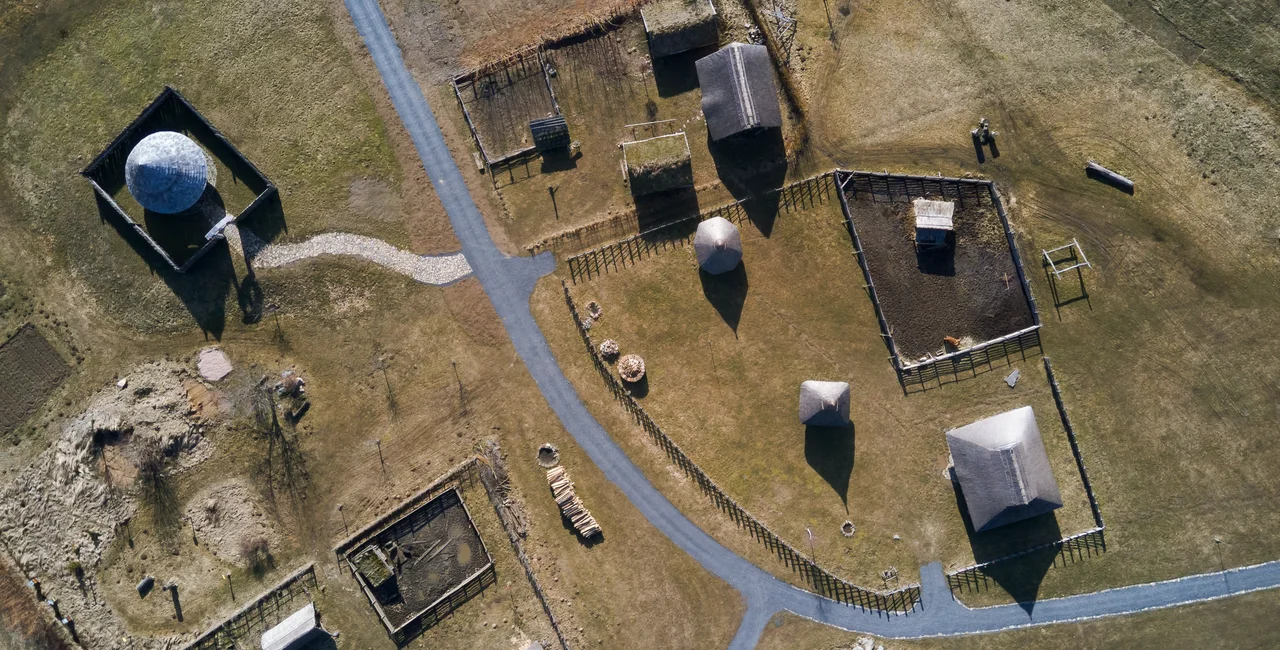
For Prague residents, one of the clearest places to explore that later chapter is Závist, on the capital’s southern edge.
The hill above the confluence of the Vltava and Berounka preserves evidence of a long sequence of settlement. Its best-known phases include monumental structures from the sixth and fifth centuries BCE and a Celtic oppidum—a large fortified settlement—from the second and first centuries BCE.
The Czech Academy of Sciences’ Institute of Archaeology provides an online introduction to Závist, with resources for understanding the landscape. There is even a chatbot presented as a Celtic druid, drawing on archaeological literature to answer questions about the site and its wider context.
A walk through Závist will not reveal where Irish began. It does, however, offer a tangible encounter with the broader European world behind the question, and one in which the lands around Prague were connected to people and places far beyond modern Czechia.