Czechia's hepatitis A crisis: Shortages, skepticism, and where to find your shot

The current epidemic collides with deep vaccine distrust and critical shortages as that nation faces a triple threat to stopping a surging health.

Expats.cz Staff

Written by Expats.cz Staff Published on 22.10.2025 14:37:00 (updated on 23.10.2025) Reading time: 3 minutes

Healthcare providers across Prague and nationwide are seeing a surge in demand for flu shots and hepatitis A vaccines this autumn. Yet, this massive immunization effort is battling not only a highly contagious virus but also a profound, deep-rooted vaccine skepticism, a cultural barrier now intensified by critical vaccine shortages.

Now an epidemic: The human cost

The situation is rapidly escalating. As of Oct. 22, the nationwide outbreak of hepatitis A, a highly contagious viral liver disease, has surged to 2,141 infections. The State Health Institute (SZÚ) reports the disease has killed 26 people nationwide in the past year, with 10 of those deaths occurring in the capital.

The nation’s leading professional medical body, the Czech Medical Society of Jan Evangelista Purkyně, has declared this year’s surge an epidemic, the country’s second-highest count since 1989.

In response, interest in vaccination has skyrocketed: over 112,000 people in Czechia have been vaccinated against hepatitis A this year, nearly double the number recorded for all of 2024. Experts attribute the surge to the cumulative impact of low vaccination coverage and the loss of natural immunity after decades without a major outbreak.

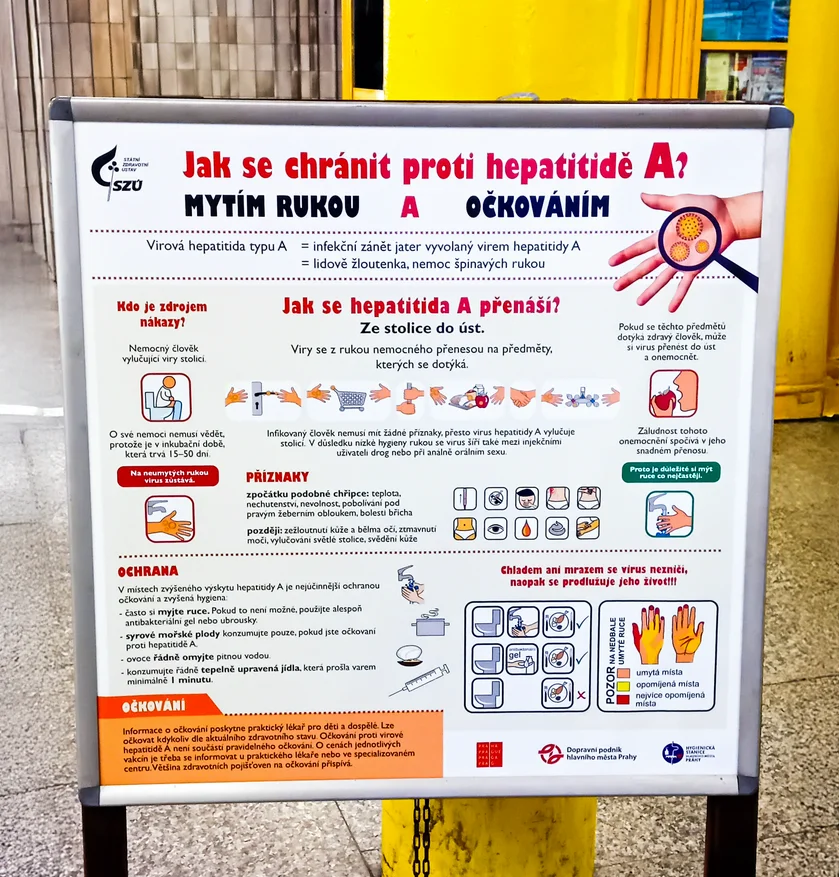
Hepatitis A sign in Florenc metro

Vaccine hesitancy: A cultural barrier

Despite the urgent medical consensus, the greatest challenge to achieving widespread immunity is a profound cultural skepticism, deeply ingrained in Czech society.

AGENCY PROPERTIES

Building plot for sale, 518m<sup>2</sup>

Building plot for sale, 518m2

U plynárny, Praha 4 - Michle

Family house for sale, 191m<sup>2</sup>, 518m<sup>2</sup> of land

Family house for sale, 191m2, 518m2 of land

U plynárny, Praha 4 - Michle

Apartment for rent, 3+kk - 2 bedrooms, 82m<sup>2</sup>

Apartment for rent, 3+kk - 2 bedrooms, 82m2

Melodická, Praha 5 - Stodůlky

Apartment for rent, 2+kk - 1 bedroom, 48m<sup>2</sup>

Apartment for rent, 2+kk - 1 bedroom, 48m2

Pod Harfou, Praha 9 - Vysočany

A wide-scale 2025 study on vaccination trends in Central and Eastern Europe highlights multiple factors shaping attitudes, including a historical distrust of authorities and socio-cultural norms that favor self-reliance. The authors noted that “increasing exposure to vaccine misinformation has emerged as a significant threat to long-term vaccination trends."

Domestically, the skepticism is so deeply imbued that it requires a state-level defense. The study confirms that “a state-funded communication initiative to debunk vaccine myths provoked public debate, reflecting tensions around the government’s role in shaping information.”

This sense of invulnerability, reinforced by decades without major outbreaks and amplified by fears about vaccine safety on social media, has made the skepticism a systemic challenge.

On an EU-wide level, people in the Czech Republic were the seventh-most skeptical nation in the European Commission’s most recent survey, with almost three in 10 people disagreeing that vaccines were “safe.”

Overcoming the access gap

To overcome both access barriers and lingering skepticism, some providers are streamlining the process.

IKEM chief epidemiologist Petr Smejkal observed earlier this year: “If we want to increase the vaccination rate of the Czech population, we must make vaccines more available where people naturally go.”

In line with this philosophy, the Benu pharmacy chain in Czechia has piloted a walk-in vaccine program across four of its pharmacies, including the location at Westfield Chodov.

Benu CEO Petr Doležal noted that the company aims to contribute to a higher vaccination rate and gather data on public interest in vaccination outside of traditional doctors’ offices.

Shortages complicate access

The crisis is now compounded by a supply shock. Driven by public campaigns and surging interest, the demand for hepatitis A vaccines has contributed to local shortages, despite a significant increase in supply earlier this year.

Czech Television reports that the common vaccine, Avaxim 160U, will be unavailable until at least December 15, while another frequently used vaccine is expected to be out of stock until March 2026, according to the SZÚ.

General practitioners and pharmacies across Prague are already experiencing interruptions. Some residents are now turning to the more expensive combined hepatitis A and B vaccine, Twinrix, as a temporary alternative.

System-level barriers, uneven distribution, and limited public communication worsen hesitancy and create gaps in coverage even when vaccines exist. With the hepatitis A epidemic worsening in Czechia and the peak flu season approaching, the need for proactive health measures and overcoming skepticism and scarcity will only rise.

💉 Vaccinations in Prague: Where to get them

  • Your local GP: Praktický lékař (GP) practices offer seasonal flu vaccines. Check with your registered GP.
  • University hospitals: Bulovka, Motol, or Thomayer hospitals require advance reservations; Thomayer Hospital accepts walk-ins Monday–Thursday mornings.
  • Pharmacies offering flu and travel vaccines: See Benu’s trial program here. It also offers weekend reservations for self-payers.
  • Private and travel-medicine clinics: These centers will vaccinate you at short notice, but expect to pay a premium.
  • Cost: Around CZK 1,700 to CZK 1,800 for two doses, with partial reimbursement from insurers.
Every business has a story. Let's make yours heard. Click here