Your next delivery could fly: How close is Czechia to shopping by drone?

Drone deliveries are already reaching homes abroad. In Czechia, the next step could begin in a supermarket parking lot, but several hurdles remain.

Dave Park

Written by Dave Park Published on 20.11.2026 12:33:00 (updated on 20.11.2026) Reading time: 3 minutes
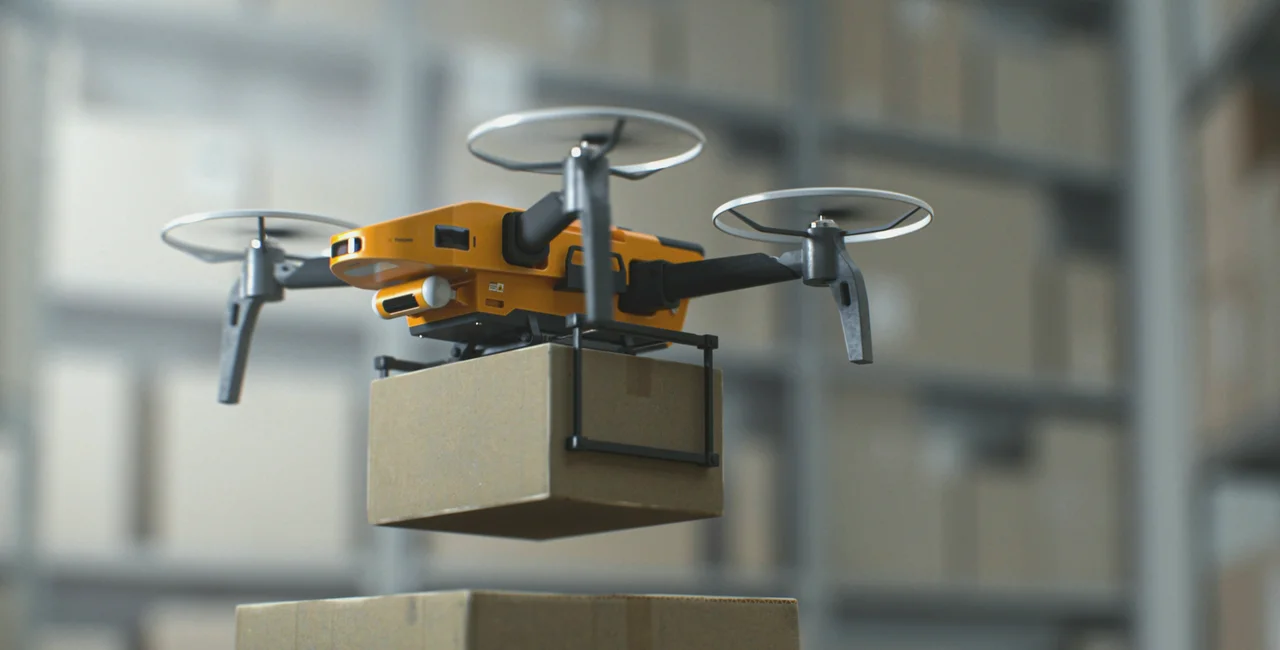
You discover a missing ingredient halfway through cooking dinner. Instead of walking to the supermarket or waiting for a courier, you order it on your phone. Minutes later, a drone lowers a package into your garden.

That service already exists in selected locations abroad. Whether it could work for your Czech address depends on more than how quickly a drone can fly.

A new analysis from property consultancy Colliers suggests that supermarket parking lots and retail parks could become launch sites for Czech delivery networks. Existing shops would supply the goods, while unused outdoor space could accommodate the aircraft.

For customers, the prospect is rapid delivery of a few essentials. For property owners, it is a potential new use for space currently occupied by cars. But the analysis does not announce a Czech consumer launch date, participating stores or bookable delivery routes.

The delivery arrives in your garden—not at your door

The clearest way to understand drone delivery is to look at how customers actually receive an order.

Wing, the drone operator owned by Google parent Alphabet, asks customers in its service areas to check their address and select a precise delivery spot, such as a driveway or backyard. Eligible goods are lowered to the ground, and customers collect them after the aircraft departs.

Its ordering instructions emphasize that smaller items are more likely to qualify. This is a service suited to a forgotten ingredient or a small purchase, rather than an unrestricted replacement for the weekly shop.

Irish operator Manna uses a similar approach: an aircraft collects an order from a local business, flies to the customer and lowers it on a tether without landing. The company reports hundreds of thousands of commercial deliveries in Europe and the United States.

For Prague residents, that raises an obvious practical question: where would the package go?

A home with an accessible garden presents a different delivery problem from an upper-floor apartment overlooking a busy street. The suburban model described by Colliers therefore appears a more plausible starting point than routine deliveries into the historic center.

Why the supermarket parking lot matters

Colliers argues that the economics depend heavily on having enough conveniently located launch sites. Shorter flights between stores and surrounding households could reduce costs and allow aircraft to complete more deliveries.

Blanka Sovová, the company’s director of retail real estate, identifies unused sections of parking lots and service areas behind shopping centers as potential locations.

The appeal is straightforward: retailers already have stock, staff and customers nearby. A delivery network could build around those assets instead of constructing separate facilities.

That does not establish that drones will automatically be cheaper than couriers. Colliers itself says individual drone deliveries remain comparatively expensive. Its property argument is that a denser network could improve the economics.

It also helps explain the focus on small, urgent purchases: speed is easier to sell when someone needs an item immediately.

Czechia has been testing the idea for years. Colliers points to Mall.cz’s November 2016 demonstration, when a package traveled 1.7 kilometers from Jirny to Zeleneč in approximately three minutes.

More recently, Aerovision announced a delivery-drone development center at Příbram airport in March 2025. That announcement described testing and development ambitions, rather than an established household delivery service.

Czech logistics company DODO has also experimented abroad. Its trial with Rossmann in Budapest involved locations 15 kilometers apart and took 14 minutes from securing the delivery container through the flight and associated maneuvers.

A clear flight path still needs permission

One important development is U-space, the European framework for services that help coordinate drone traffic in designated airspace.

It is sometimes presented as the switch that will unlock delivery networks. The reality is more gradual.

In September 2026, the Czech Civil Aviation Authority invited prospective operators and service providers to discuss future Czech U-space arrangements, including traffic density, risk assessments and operating requirements.

The European Union Aviation Safety Agency also makes clear that existing drone operating requirements continue to apply within U-space. Flights beyond the pilot’s visual line of sight fall within the more demanding “specific” category, which generally requires operational authorization unless an applicable alternative approval route covers the operation.

Traffic-management infrastructure therefore does not amount to blanket permission for retailers to start flying purchases over neighborhoods.

For Czech customers, the milestone to watch is a named service with approved routes, eligible addresses, delivery charges and a launch date. Until then, the supermarket parking lot is a plausible departure point, but your garden is still a proposed destination.

Did you like this article?

Want to see more from us? Select Expats.cz as a preferred source on Google.