 Reading time: 2 minutes

 Summary for: Banned 1963 art show returns to Prague’s Museum Kampa
A landmark 1963 exhibition by Czech artists Mikuláš Medek and Jan Koblasa has been reconstructed at Prague’s Museum Kampa, bringing together works once condemned by the communist authorities.
Opening Saturday, Oct. 3, In Defiance marks the centenary of Medek’s birth and revisits the artists’ groundbreaking joint exhibition at Teplice Castle. It will run alongside new exhibitions devoted to sculptor Květa Kovářová and Czech-German painter Milan Kunc.

The reconstruction follows the discovery of Jiří Hampl’s original photographic documentation, which allowed curators to reproduce much of the appearance and selection of the 1963 show.
An exhibition that defied communist restrictions
Medek and Koblasa, both prominent figures in Czech postwar art, were frequently prevented from exhibiting because their abstract and expressionist work did not conform to the communist regime’s cultural doctrine.
They received unexpected permission to show their work at Teplice Castle during a short period of political and cultural relaxation in 1963. The opportunity followed the appointment of the comparatively liberal Čestmír Císař to a senior role overseeing culture.
The artists displayed their latest works from 1959 to 1963. The resulting exhibition became an unusual cultural event, reportedly attracting around 400 visitors per day despite harsh criticism in the state-controlled press.
Museum Kampa’s reconstruction includes 12 Medek paintings shown in Teplice, along with another 13 works borrowed from public and private collections. Sculptures and painting cycles by Koblasa have also been assembled to reflect the original show.
Koblasa later became one of the leading figures of the Czechoslovak art scene of the 1960s. Medek, now regarded as one of Czechia’s most important modern painters, died in 1974 at age 47.
Forgotten sculptor and exile painter revisited
A second exhibition, For the Shape of the Figure, presents what Museum Kampa describes as the first comprehensive survey of Květa Kovářová’s work.
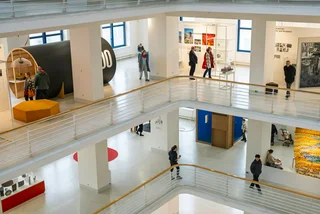
Kovářová experimented with materials including wood, plaster, resin, industrial glass foam and modeling compounds. Her figures gradually moved from recognizable human forms toward increasingly abstract shapes.
The sculptor died in 1966 at age 41 after part of a 3.5-meter clay fountain model collapsed on her inside her studio. The exhibition brings together nearly all of her surviving available works and runs through Nov. 22.
Museum Kampa is also staging Pop Renaissance, a retrospective devoted to Milan Kunc. Prevented from completing his studies at Prague’s Academy of Fine Arts because of an alleged lack of talent, Kunc emigrated to West Germany in 1969 and later established an international career.

His colorful, ironic paintings explore consumerism, ideology, sexuality, ecology and the power of commercial images. The Kunc and Medek-Koblasa exhibitions both run through Jan. 17, 2027.
Further information is available through the official Museum Kampa pages for In Defiance, For the Shape of the Figure and Pop Renaissance.