


 Reading time: 3 minutes

 Summary for: At the world’s largest brewer, multilingualism is a game changer for job seekers
You may have heard that the best way to get an entry-level job in Czechia is to have the perfect CV or a highly specialized skill set. While those are great assets to have, there is another way you can greatly enhance your chances of getting hired at a top international firm: knowledge of another language.
“We’re continuously looking to hire multilingual candidates,” said Mariya Kozlyuk, Talent Acquisition Lead Europe. “At the moment, Dutch, German, and French are particularly valuable. Of course, fluency in English remains essential, as it’s our primary language for internal and external communication.”
We spoke with several employees at the company, to understand more about how multilingualism enhances their careers at AB InBev and to learn why knowing another language is the job application superpower career professionals didn’t know they needed.
Why language skills still matter in a tech-driven job market
In Prague, AB InBev employs more than 800 people from 72 nationalities, so language skills remain important, especially as the company supports multiple markets, including some in their native languages. Does that mean you have to show off your language certificates to get that much-coveted job interview? Not necessarily.
Although most university graduates in Europe have a high level of competence on paper in several languages, there is a difference between written test proficiency and real life.

That’s one reason French native Thomas Fitting, Credit and Collections Supervisor at AB InBev, spent a year in Australia on a Working Holiday Visa following his university studies. Thomas also boosted his intercultural communication skills by working and living in different countries, including Indonesia, Spain, Morocco, and Sri Lanka.
English dominates Thomas' communication at work, but French is also essential to his role as a manager of teams in France, Luxembourg and Belgium. Like many AB InBev employees, he gains multilingual flexibility organically.
“Overall, I adapt the language depending on the audience to ensure clarity, efficiency, and strong relationships,” explains Thomas, who also studied Spanish. He noted that being able to communicate informally in a language, like knowing the idioms and current slang, is invaluable for having more personal and welcoming one-to-one meetings.
Thomas also cites multilingualism as a key factor in developing leadership potential.
“My experience with multiple languages has made me more empathetic and flexible in the way I interact with others,” he adds. “Being able to rephrase, simplify, or adjust my message depending on the person allows me to avoid misunderstandings and move faster.”
How AB InBev teams use languages in daily work
English is the main language of communication at AB InBev, but multilingual employees may also use other languages when the context calls for it.
For instance, Damien Grout De Beaufort, an Operational Planning Manager from France, notes that for him and his colleagues, “it’s quite common to switch languages in the middle of a conversation or meeting.”
“We may begin a meeting in English, only to realize that everyone shares the same native language and can easily switch to it,” he said. Damien is a native French speaker who is fluent in English and has some proficiency in Spanish.
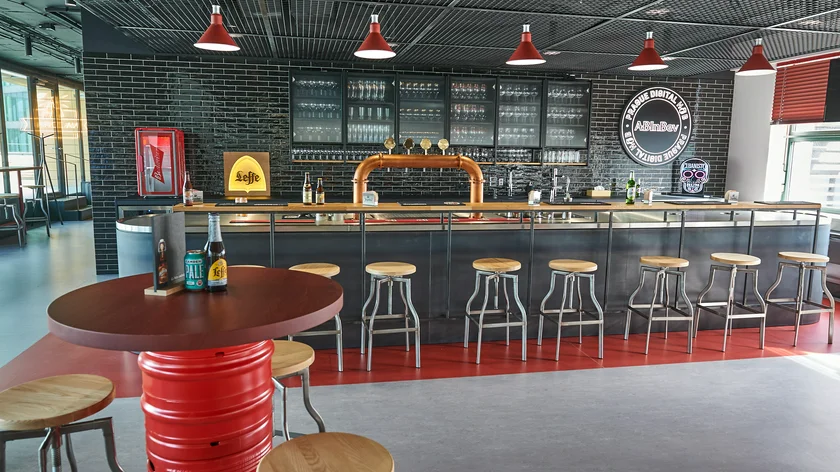

For Damien’s day-to-day work, language skills simplify the organization of on-site visits to clients and suppliers, and enable a level of efficient collaboration without the delays that translation naturally requires.
Like Thomas, Philip Werner, a Customer Experience Lead, predominantly relies on English at work. Originally from Germany, Philip credits his bilingualism for his career growth.
“I was able to move to Prague as Customer Experience Lead for Germany because I could speak the language of the market internally and externally,” he explains.
“Looking across my team I also see a lot of other great examples of individuals where speaking the German language allowed them to develop their careers,” said Philip.
Beyond climbing the corporate ladder, perhaps the biggest advantage of language versatility is how it impacts your life at the end of the work day.
“For me, being in a multilingual environment at AB InBev is really at the heart of the company’s culture, especially in Prague,” Philip emphasizes. “It’s a place where people from so many different backgrounds come together. You can easily find yourself sharing a beer with five or more colleagues from different nationalities.”
Ready to put your language skills to work? Explore roles across Finance, Customer Experience, Supply and Logistics, Human Resources, IT, and more.